SNCF 300-710 Category

SNCF Questions – Part 1

September 30th, 2022

Question 1

What is the role of the casebook feature in Cisco Threat Response?

A. sharing threat analysts
B. pulling data via the browser extension
C. triage automaton with alerting
D. alert prioritization


Answer: A

Explanation

Casebook – It is used to record, organize, and share sets of observables of interest primarily during an investigation and threat analysis. You can use a casebook to get the current verdicts or dispositions on the observables.

Reference: https://www.cisco.com/c/en/us/td/docs/security/ces/user_guide/esa_user_guide_13-5-1/b_ESA_Admin_Guide_ces_13-5-1/b_ESA_Admin_Guide_13-0_chapter_0110001.pdf

Question 2

An administrator is adding a new URL-based category feed to the Cisco FMC for use within the policies. The intelligence source does not use STIX. but instead uses a .txt file format. Which action ensures that regular updates are provided?

A. Add a URL source and select the flat file type within Cisco FMC.
B. Upload the .txt file and configure automatic updates using the embedded URL.
C. Add a TAXII feed source and input the URL for the feed.
D. Convert the .txt file to STIX and upload it to the Cisco FMC.


Answer: A

Question 3

An engineer installs a Cisco FTD device and wants to inspect traffic within the same subnet passing through a firewall and inspect traffic destined to the Internet. Which configuration will meet this requirement?

A. transparent firewall mode with IRB only
B. routed firewall mode with BVI and routed interfaces
C. transparent firewall mode with multiple BVIs
D. routed firewall mode with routed interfaces only


Answer: B

Question 4

A network administrator configured a NAT policy that translates a public IP address to an internal web server IP address. An access policy has also been created that allows any source to reach the public IP address on port 80. The web server is still not reachable from the Internet on port 80. Which configuration change is needed?

A. The intrusion policy must be disabled for port 80.
B. The access policy rule must be configured for the action trust.
C. The NAT policy must be modified to translate the source IP address as well as destination IP address.
D. The access policy must allow traffic to the internal web server IP address.


Answer: D

Question 5

A network administrator is migrating from a Cisco ASA to a Cisco FTD. EIGRP is configured on the Cisco ASA but it is not available in the Cisco FMC. Which action must the administrator take to enable this feature on the Cisco FTD?

A. Configure EIGRP parameters using FlexConfig objects.
B. Add the command feature-eigrp via the FTD CLI.
C. Create a custom variable set and enable the feature in the variable set.
D. Enable advanced configuration options in the FMC.


Answer: A

Explanation

EIGRP is not natively supported by FTD so we need to use FlexConfig to push EIGRP commands to FTD.
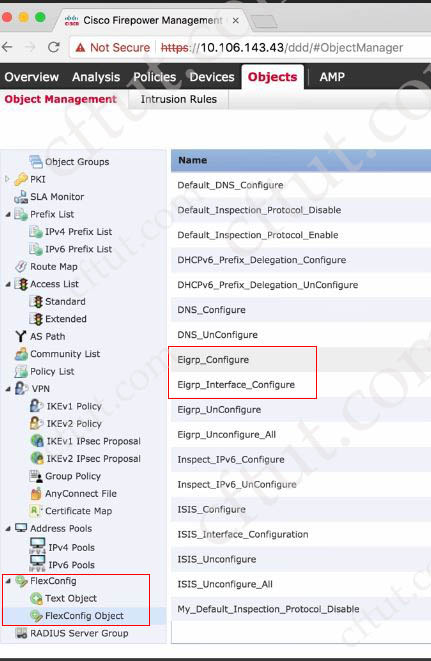
EIGRP_FMC_flexConfig_Object.jpg

Question 6

A security engineer found a suspicious file from an employee email address and is trying to upload it for analysis, however the upload is failing. The last registration status is still active. What is the cause for this issue?

A. Cisco AMP for Networks is unable to contact Cisco Threat Grid on premise.
B. Cisco AMP for Networks is unable to contact Cisco Threat Grid Cloud.
C. There is a host limit set.
D. The user agent status is set to monitor.


Answer: C

Question 7

An administrator is attempting to add a new FTD device to their FMC behind a NAT device with a NAT ID of NAT001 and a password of Cisco0420l06525. The private IP address of the FMC server is 192.168.45.45 which is being translated to the public IP address of 209.165.200.225/27. Which command set must be used in order to accomplish this task?

A. configure manager add 209.165.200.225 <reg_key> <nat_id>
B. configure manager add 192.168.45.45 <reg_key> <nat_id>
C. configure manager add 209.165.200.225 255.255.255.224 <reg_key> <nat_id>
D. configure manager add 209.165.200.225/27 <reg_key> <nat_id>


Answer: A

Question 8

A security analyst must create a new report within Cisco FMC to show an overview of the daily attacks, vulnerabilities, and connections. The analyst wants to reuse specific dashboards from other reports to create this consolidated one. Which action accomplishes this task?

A. Create a dashboard object via Object Management to represent the desired views.
B. Modify the Custom Workflows within the Cisco FMC to feed the desired data into the report.
C. Copy the Malware Report and modify the sections to pull components from other reports.
D. Use the import feature in the newly created report to select which dashboards to add.


Answer: D

Question 9

A network engineer must provide redundancy between two Cisco FTD devices. The redundancy configuration must include automatic configuration, translation, and connection updates. After the initial configuration of the two appliances, which two steps must be taken to proceed with the redundancy configuration? (Choose two)

A. Configure the virtual MAC address on the failover link.
B. Disable hellos on the inside interface.
C. Configure the standby IP addresses.
D. Ensure the high availability license is enabled.
E. Configure the failover link with stateful properties.


Answer: C E

Explanation

Configure FTD High Availability on Firepower Appliances


Step 4. Configure the Data interfaces (primary and standby IP addresses)
Step 10. Stay on the High Availability tab and configure Virtual MAC addresses

Reference: https://www.cisco.com/c/en/us/support/docs/security/firepower-management-center/212699-configure-ftd-high-availability-on-firep.html

We don’t configure the virtual MAC on the failover link but on the link to the network -> Answer A is not correct.

Question 10

An engineer attempts to pull the configuration for a Cisco FTD sensor to review with Cisco TAC but does not have direct access to the CLI for the device. The CLI for the device is managed by Cisco FMC to which the engineer has access. Which action in Cisco FMC grants access to the CLI for the device?

A. Export the configuration using the Import/Export tool within Cisco FMC.
B. Create a backup of the configuration within the Cisco FMC.
C. Use the show run all command in the Cisco FTD CLI feature within Cisco FMC.
D. Download the configuration file within the File Download section of Cisco FMC.


Answer: C

Question 11

Which policy rule is included in the deployment of a local DMZ during the initial deployment of a Cisco NGFW through the Cisco FMC GUI?

A. a default DMZ policy for which only a user can change the IP addresses.
B. deny ip any
C. no policy rule is included
D. permit ip any


Answer: C

Question 12

Which limitation applies to Cisco FMC dashboards in a multidomain environment?

A. Child domains can view but not edit dashboards that originate from an ancestor domain.
B. Child domains have access to only a limited set of widgets from ancestor domains.
C. Only the administrator of the top ancestor domain can view dashboards.
D. Child domains cannot view dashboards that originate from an ancestor domain.


Answer: D

Explanation

In a multidomain deployment, you cannot view dashboards from ancestor domains; however, you can create new dashboards that are copies of the higher-level dashboards.

Reference: https://www.cisco.com/c/en/us/td/docs/security/firepower/623/configuration/guide/fpmc-config-guide-v623/dashboards.html

Question 13

Which command is run on an FTD unit to associate the unit to an FMC manager that is at IP address 10.0.0.10, and that has the registration key Cisco123?

A. configure manager local 10.0.0.10 Cisco123
B. configure manager add Cisco123 10.0.0.10
C. configure manager local Cisco123 10.0.0.10
D. configure manager add 10.0.0.10 Cisco123


Answer: D

Question 14

Which Cisco Firepower feature is used to reduce the number of events received in a period of time?

A. rate-limiting
B. suspending
C. correlation
D. thresholding


Answer: D

Question 15

While integrating Cisco Umbrella with Cisco Threat Response, a network security engineer wants to automatically push blocking of domains from the Cisco Threat Response interface to Cisco Umbrella. WhichAPI meets this requirement?

A. investigate
B. reporting
C. enforcement
D. REST


Answer: C

Question 16

The CIO asks a network administrator to present to management a dashboard that shows custom analysis tables for the top DNS queries URL category statistics, and the URL reputation statistics. Which action must the administrator take to quickly produce this information for management?

A. Run the Attack report and filter on DNS to show this information.
B. Create a new dashboard and add three custom analysis widgets that specify the tables needed.
C. Modify the Connection Events dashboard to display the information in a view for management.
D. Copy the intrusion events dashboard tab and modify each widget to show the correct charts.


Answer: B

Question 17

An analyst is investigating a potentially compromised endpoint within the network and pulls a host report for the endpoint in Qto collect metrics and documentation. What information should be taken from this report for the investigation?

A. client applications by user, web applications, and user connections
B. number of attacked machines, sources of the attack, and traffic patterns
C. threat detections over time and application protocols transferring malware
D. intrusion events, host connections, and user sessions


Answer: D

Question 18

A network administrator reviews the file report for the last month and notices that all file types, except exe show a disposition of unknown. What is the cause of this issue?

A. The malware license has not been applied to the Cisco FTD.
B. The Cisco FMC cannot reach the Internet to analyze files.
C. A file policy has not been applied to the access policy.
D. Only Spero file analysis is enabled.


Answer: D

Question 19

An administrator receives reports that users cannot access a cloud-hosted web server. The access control policy was recently updated with several new policy additions and URL filtering. What must be done to troubleshoot the issue and restore access without sacrificing the organization’s security posture?

A. Create a new access control policy rule to allow ports 80 and 443 to the FQDN of the web server.
B. Identify the blocked traffic in the Cisco FMC connection events to validate the block, and modify the policy to allow the traffic to the web server.
C. Verify the blocks using the packet capture tool and create a rule with the action monitor for the traffic.
D. Download a PCAP of the traffic attempts to verify the blocks and use the flexconfig objects to create a rule that allows only the required traffic to the destination server.


Answer: B

Question 20

A network security engineer must export packet captures from the Cisco FMC web browser while troubleshooting an issue. When navigating to the address https://<FMC IP>/capture/CAPI/pcap/test.pcap, an error 403: Forbidden is given instead of the PCAP file. Which action must the engineer take to resolve this issue?

A. Disable the proxy setting on the browser
B. Disable the HTTPS server and use HTTP instead
C. Use the Cisco FTD IP address as the proxy server setting on the browser
D. Enable the HTTPS server for the device platform policy


Answer: D

Question 21

An engineer wants to change an existing transparent Cisco FTD to routed mode. The device controls traffic between two network segments. Which action is mandatory to allow hosts to reestablish communication between these two segments after the change?

A. Remove the existing dynamic routing protocol settings.
B. Configure multiple BVIs to route between segments.
C. Assign unique VLAN IDs to each firewall interface.
D. Implement non-overlapping IP subnets on each segment.


Answer: D

Question 22

An engineer is reviewing a ticket that requests to allow traffic for some devices that must connect to a server over 8699/udp. The request mentions only one IP address, 172.16.18.15, but the requestor asked for the engineer to open the port for all machines that have been trying to connect to it over the last week. Which action must the engineer take to troubleshoot this issue?

A. Use the context explorer to see the application blocks by protocol.
B. Use the context explorer to see the destination port blocks
C. Filter the connection events by the source port 8699/udp.
D. Filter the connection events by the destination port 8699/udp.


Answer: D

Question 23

An organization is migrating their Cisco ASA devices running in multicontext mode to Cisco FTD devices. Which action must be taken to ensure that each context on the Cisco ASA is logically separated in the Cisco FTD devices?

A. Add a native instance to distribute traffic to each Cisco FTD context.
B. Add the Cisco FTD device to the Cisco ASA port channels.
C. Configure a container instance in the Cisco FTD for each context in the Cisco ASA.
D. Configure the Cisco FTD to use port channels spanning multiple networks.


Answer: C

Question 24

A security engineer is configuring a remote Cisco FTD that has limited resources and internet bandwidth. Which malware action and protection option should be configured to reduce the requirement for cloud lookups?

A. Malware Cloud Lookup and dynamic analysis
B. Block Malware action and dynamic analysis
C. Block Malware action and local malware analysis
D. Block File action and local malware analysis


Answer: C

Question 25

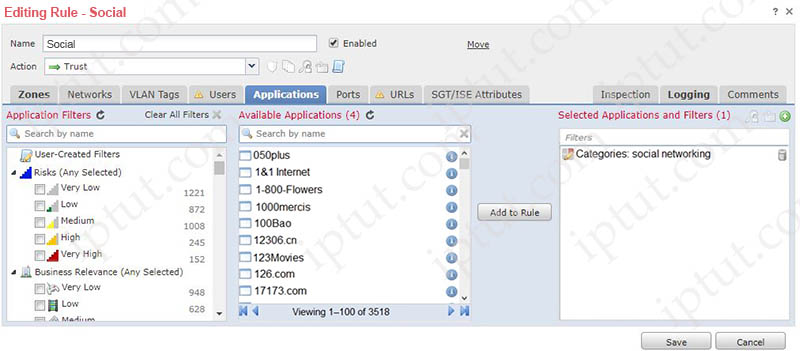
Refer to the exhibit.
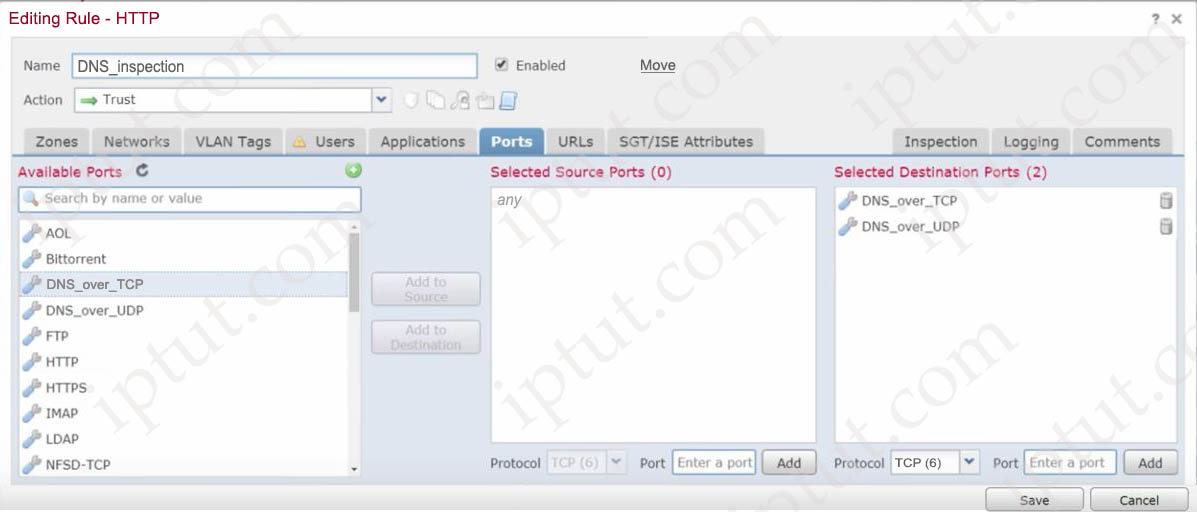
FirePower_Editing_Rule.jpg

Engineer is modifying an access control pokey to add a rule to inspect all DNS traffic that passes through the firewall. After making the change and deploying the policy they see that DNS traffic is not being inspected by the Snort engine. What is the problem?

A. The rule must specify the security zone that originates the traffic
B. The rule must define the source network for inspection as well as the port
C. The action of the rule is set to trust instead of allow.
D. The rule is configured with the wrong setting for the source port


Answer: C

Question 27

A network administrator has converted a Cisco FTD from using LDAP to LDAPS for VPN authentication. The Cisco FMC can connect to the LDAPS server, but the Cisco FTD is not connecting, Which configuration must be enable on the Cisco FTD?

A. SSL must be set to a use TLSv1.2 or lower
B. DNS servers must be defined for name resolution
C. The RADIUS server must be defined
D. The LDAPS must be allowed through the access policy


Answer: B

Question 28

A security engineer must deploy a Cisco FTD appliance as a bump in the wire to detect intrusion events without disrupting the flow of network traffic. Which two features must be configured to accomplish the task? (Choose two.)

A. inline set pair
B. transparent mode
C. tap mode
D. passive interfaces
E. bridged mode


Answer: A C

Question 29

A network administrator is configuring an FTD in transparent mode. A bridge group is set up and an access policy has been set up t o allow all IP traffic. Traffic is not passing through the FTD. What additional configuration is needed?

A. The security levels of the interfaces must be set.
B. A default route must be added to the FTD.
C. An IP address must be assigned to the BVI.
D. A mac-access control list must be added to allow all MAC addresses.


Answer: C

Question 30

What is the difference between inline and inline tap on Cisco Firepower?

A. Inline tap mode can send a copy of the traffic to another device.
B. Inline tap mode does full packet capture.
C. Inline mode cannot do SSL decryption.
D. Inline mode can drop malicious traffic.


Answer: D

Question 31

What are the minimum requirements to deploy a managed device inline?

A. inline interfaces, security zones, MTU, and mode
B. passive interface, MTU, and mode
C. inline interfaces, MTU, and mode
D. passive interface, security zone, MTU, and mode


Answer: C

Question 32

What are two application layer preprocessors? (Choose two)

A. CIFS
B. IMAP
C. SSL
D. DNP3
E. ICMP


Answer: A B

Explanation

CIFS (Common Internet File System) and SMB (Server Message Block) are network protocols used for sharing files, printers, and other resources between computers. Both CIFS and SMB operate at the application layer of the OSI networking model and are commonly used for file and printer sharing in Windows environments. -> Answer A is correct.

Reference: https://www.appviewx.com/glossary/common-internet-file-system-server-message-block-cifs-smb/

IMAP, or Internet Message Access Protocol, operates at the Application Layer (Layer 7) of the Open Systems Interconnection (OSI) model, handling email retrieval and organization from mail servers. -> Answer B is correct.

Note: SSL operates at Layer 6 of the OSI model – Presentation Layer (for data representation and encryption).

Question 33

With Cisco Firepower Threat Defense software, which interface mode must be configured to passively receive traffic that passes through the appliance?

A. inline set
B. passive
C. routed
D. inline tap


Answer: D

Explanation

In passive mode, the copy of the traffic will be sent to FTD from a network device for traffic inspection, and original traffic never passes through it. ‘Inline TAP’ also copies the traffic passing through the appliance, but no action is taken.

Question 34

Which two statements about bridge-group interfaces in Cisco FTD are true? (Choose two.)

A. The BVI IP address must be in a separate subnet from the connected network.
B. Bridge groups are supported in both transparent and routed firewall modes.
C. Bridge groups are supported only in transparent firewall mode.
D. Bidirectional Forwarding Detection echo packets are allowed through the FTD when using bridge- group members.
E. Each directly connected network must be on the same subnet.


Answer: B E

Explanation

A bridge group is a group of interfaces that the FTD device bridges instead of routes. Bridge groups are supported in both transparent and routed firewall mode.”

Reference: https://www.cisco.com/c/en/us/td/docs/security/firepower/670/configuration/guide/fpmc-config-guide-v67/transparent_or_routed_firewall_mode_for_firepower_threat_defense.html

-> Answer B is correct.

Bridge Group Guidelines (TransparentMode)
• You can create up to 250 bridge groups,with 4 interfaces per bridge group.
Each directly-connected network must be on the same subnet. -> Answer E is correct.

Reference: https://www.cisco.com/c/en/us/td/docs/security/firepower/601/configuration/guide/fpmc-config-guide-v601/fpmc-config-guide-v601_chapter_01101010.pdf

Question 35

An engineer wants to add an additional Cisco FTD Version 6.2.3 device to their current 6.2.3 deployment to create a high availability pair. The currently deployed Cisco FTD device is using local management and identical hardware including the available port density to enable the failover and stateful links required in a proper high availability deployment. Which action ensures that the environment is ready to pair the new Cisco FTD with the old one?

A. Change from Cisco FDM management to Cisco FMC management on both devices and register them to FMC.
B. Ensure that the two devices are assigned IP addresses from the 169 254.0.0/16 range for failover interfaces.
C. Factory reset the current Cisco FTD so that it can synchronize configurations with the new Cisco FTD device.
D. Ensure that the configured DNS servers match on the two devices for name resolution.


Answer: A

Question 36

An administrator must use Cisco FMC to install a backup route within the Cisco FTD to route traffic in case of a routing failure with primary route. Which action accomplish this task?

A. Install the static backup route and modify the metric to be less than the primary route
B. Use a default route in the FMC instead of having multiple routes contending for priority
C. Configure EIGRP routing on the FMC to ensure that dynamic routes are always updated
D. Create the backup route and use route tracking on both routes to a destination IP address in the network


Answer: D

Question 37

An administrator is setting up a Cisco FMC and must provide expert mode access for a security engineer. The engineer is permitted to use only a secured out-of-band network workstation with a static IP address to access the Cisco FMC. What must be configured to enable this access?

A. Enable HTTP and define an access list
B. Enable HTTPS and SNMP under the Access List section
C. Enable SCP under the Access List section
D. Enable SSH and define an Access List


Answer: D

Explanation

From FMC version 6.3, we can Enable CLI Access on the System > Configuration > Console Configuration page.
• Checked: Logging into the FMC using SSH accesses the CLI.
• Unchecked: Logging into FMC using SSH accesses the Linux shell. This is the default state
for fresh Version 6.3 installations as well as upgrades to Version 6.3 from a previous release.

Reference: https://www.cisco.com/c/en/us/td/docs/security/firepower/640/configuration/guide/fpmc-config-guide-v64/command_line_reference.pdf

To enter expert mode, use the expert command in the CLI to access the Linux shell. Users with Linux shell access can obtain root privileges, which can present a security risk. Therefore we should define an access-list to limit who can access the expert mode.

Question 38

What is the RTC workflow when the infected endpoint is identified?

A. Cisco ISE instructs Cisco AMP to contain the infected endpoint.
B. Cisco ISE instructs Cisco FMC to contain the infected endpoint.
C. Cisco AMP instructs Cisco FMC to contain the infected endpoint.
D. Cisco FMC instructs Cisco ISE to contain the infected endpoint.


Answer: D

Question 39

Due to an increase in malicious events, a security engineer must generate a threat report to include intrusion events, malware events, and security intelligence events. How is this information collected in a single report?

A. Run the default Firepower report.
B. Export the Attacks Risk report.
C. Generate a malware report.
D. Create a Custom report.


Answer: D

Question 40

Which interface type allows packets to be dropped?

A. passive
B. inline
C. ERSPAN
D. TAP


Answer: B

Question 41

An organization does not want to use the default Cisco Firepower block page when blocking HTTP traffic. The organization wants to include information about its policies and procedures to help educate the users whenever a block occurs. Which two steps must be taken to meet these requirements? (Choose two.)

A. Edit the HTTP request handling in the access control policy to customized block
B. Modify the system-provided block page result using Python
C. Create HTML code with the information for the policies and procedures
D. Change the HTTP response in the access control policy to custom
E. Write CSS code with the information for the policies and procedures


Answer: C D

Question 42

A connectivity issue is occurring between a client and a server which are communicating through a Cisco Firepower device While troubleshooting, a network administrator sees that traffic is reaching the server, but the client is not getting a response. Which step must be taken to resolve this issue without initiating traffic from the client?

A. Use packet-tracer to ensure that traffic is not being blocked by an access list.
B. Use packet capture to ensure that traffic is not being blocked by an access list.
C. Use packet capture to validate that the packet passes through the firewall and is NATed to the corrected IP address.
D. Use packet-tracer to validate that the packet passes through the firewall and is NATed to the corrected IP address.


Answer: D

Question 43

A company has many Cisco FTD devices managed by a Cisco FMC. The security model requires that access control rule logs be collected for analysis. The security engineer is concerned that the Cisco FMC will not be able to process the volume of logging that will be generated. Which configuration addresses concern this?

A. Send Cisco FTD connection events directly to a SIEM system and forward security events from Cisco FMC to the SIEM system for storage and analysis
B. Send Cisco FTD connection events and security events directly to SIEM system for storage and analysis
C. Send Cisco FTD connection events and security events to a cluster of Cisco FMC devices for storage and analysis
D. Send Cisco FTD connection events and security events to Cisco FMC and configure it to forward logs to SIEM for storage and analysis


Answer: A

Explanation

Since FTD 6.3 syslogs can be sent from FTD directly.

FMC_SIEM_storage.jpg

Therefore the best solution is sending connection & intrusion events directly to SIEM and forwarding security events from FMC to SIEM.

Reference: https://panenka.sk/cisco-fmc-ftd-eventing/

Question 44

An engineer is setting up a new Firepower deployment and is looking at the default FMC policies to start the implementation. During the initial trial phase, the organization wants to test some common Snort rules while still allowing the majority of network traffic to pass. Which default policy should be used?

A. Maximum Detection
B. Security Over Connectivity
C. Balanced Security and Connectivity
D. Connectivity Over Security


Answer: D

Question 45

An engineer integrates Cisco FMC and Cisco ISE using pxGrid. Which role is assigned for Cisco FMC?

A. server
B. controller
C. publisher
D. client


Answer: A

Explanation

pxGrid stands for Platform Exchange Grid, and it is a technology that allows integrating multiple vendors security products together and grouping them in an ecosystem domain. The main purpose of using pxGrid is to share contextual data between the integrated partners.

From the video “ISE-FMC Integration via pxGrid” at https://video.cisco.com/detail/video/6365564040112, we learn that FMC is the client.
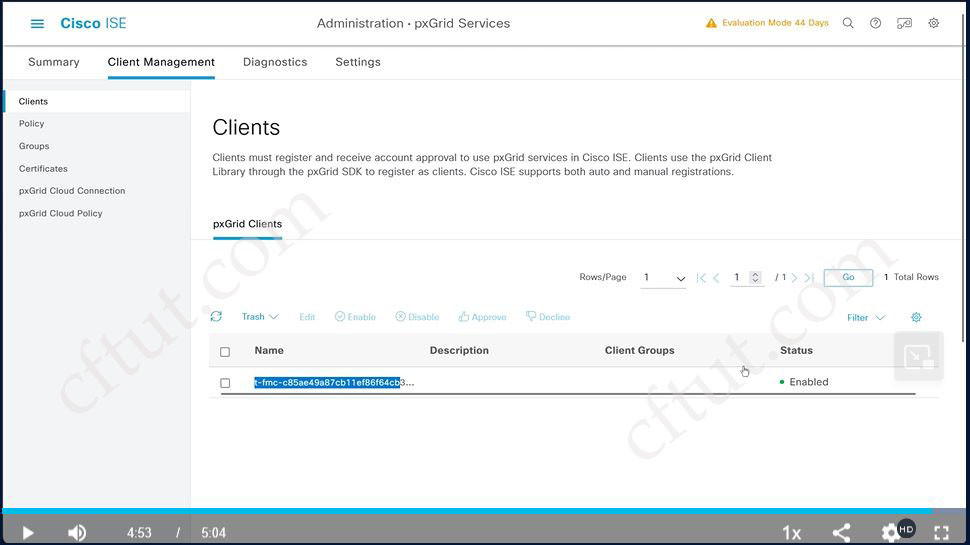
FMC_ISE_pxGrid_integrate.jpg

Question 46

A network administrator notices that remote access VPN users are not reachable from inside the network. It is determined that routing is configured correctly, however return traffic is entering the firewall but not leaving it. What is the reason for this issue?

A. A manual NAT exemption rule does not exist at the top of the NAT table.
B. An external NAT IP address is not configured.
C. An external NAT IP address is configured to match the wrong interface.
D. An object NAT exemption rule does not exist at the top of the NAT table.


Answer: A

Question 47

An engineer is troubleshooting connectivity to the DNS servers from hosts behind a new Cisco FTD device. The hosts cannot send DNS queries to servers in the DMZ. Which action should the engineer take to troubleshoot this issue using the real DNS packets?

A. Use the packet capture tool to check where the traffic is being blocked and adjust the access control or intrusion policy as needed
B. Use the Connection Events dashboard to check the block reason and adjust the inspection policy as needed
C. Use the packet tracer tool to determine at which hop the packet is being dropped
D. Use the show blocks command in the Threat Defense CLI tool and create a policy to allow the blocked traffic


Answer: B

Explanation

It seems a DNS policy has blocked the DNS queries so we should check the “Connection Events” dashboard first to find out the issue.
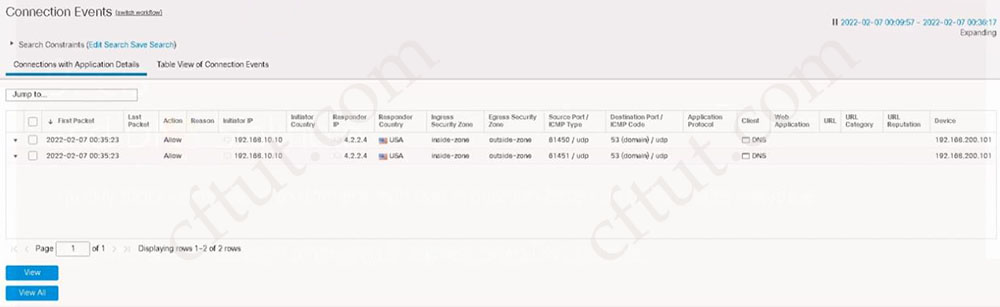
FMC_Connection_Events.jpg

Question 48

A network engineer implements a new Cisco Firepower device on the network to take advantage of its intrusion detection functionality. There is a requirement to analyze the traffic going across the device, alert on any malicious traffic, and appear as a bump in the wire How should this be implemented?

A. Specify the BVl IP address as the default gateway for connected devices.
B. Enable routing on the Cisco Firepower
C. Add an IP address to the physical Cisco Firepower interfaces.
D. Configure a bridge group in transparent mode.


Answer: D

Question 49

Which Cisco FMC report gives the analyst information about the ports and protocols that are related to the configured sensitive network for analysis?

A. Malware Report
B. Host Report
C. Firepower Report
D. Network Report


Answer: D

Question 50

A security engineer must configure a Cisco FTD appliance to inspect traffic coming from the internet. The Internet traffic will be mirrored from the Cisco Catalyst 9300 Switch. Which configuration accomplishes the task?

A. Set interface configuration mode to none.
B. Set the firewall mode to transparent.
C. Set the firewall mode to routed.
D. Set interface configuration mode to passive.


Answer: D

Question 51

A network administrator registered a FTD to an existing FMC. The administrator cannot place the FTD in transparent mode. Which action enables transparent mode?

A. Add a Bridge Group Interface to the FTD before transparent mode is configured.
B. Deregister the FTD device from FMC and configure transparent mode via the CLI.
C. Obtain an FTD model that supports transparent mode.
D. Assign an IP address to two physical interfaces.


Answer: B

Question 52

An engineer must add DNS-specific rules to the Cisco FTD intrusion policy. The engineer wants to use the rules currently in the Cisco FTD Snort database that are not already enable but does not want to enable more than are needed.Which action meets these requirements?

A. Change the base policy to Security over Connectivity
B. Change the dynamic state of the rule within the policy
C. Change the rules using the Generate and use recommendations feature
D. Change the rule state within the policy being used


Answer: C

Question 53

A network administrator is trying to convert from LDAP to LDAPS for VPN user authentication on a Cisco FTD. Which action must be taken on the Cisco FTD objects to accomplish this task?

A. Identify the LDAPS cipher suite and use a cipher suite list object to define the Cisco FTD connection requirements
B. Add a key chain object to acquire the LDAP certificate
C. Create a certificate enrollment object to get the LDAPS certificate needed
D. Modify the policy list object to define the session requirements LDAPS


Answer: C

Question 54

A security engineer is deploying a pair of primary and secondary Cisco FMC devices. The secondary must also receive updates from Cisco Talos. Which action achieves this goal?

A. Force failover for the secondary Cisco FMC to synchronize the rule updates from the primary.
B. Configure the secondary Cisco FMC so that it receives updates from Cisco Talos.
C. Manually import rule updates onto the secondary Cisco FMC device.
D. Configure the primary Cisco FMC so that the rules are updated.


Answer: D

Explanation

If your deployment includes a high availability pair of Firepower Management Centers, import the update on the primary only. The secondary Firepower Management Center receives the rule update as part of the regular synchronization process.

Reference: https://www.cisco.com/c/en/us/td/docs/security/firepower/670/configuration/guide/fpmc-config-guide-v67/system_software_updates.html

Question 55

Which two statements about deleting and re-adding a device to Cisco FMC are true? (Choose two.)

A. An option to re-apply NAT and VPN policies during registration is available, so users do not need to re-apply the policies after registration is completed.
B. Before re-adding the device in Cisco FMC, you must add the manager back in the device.
C. No option to delete and re-add a device is available in the Cisco FMC web interface.
D. The Cisco FMC web interface prompts users to re-apply access control policies.
E. No option to re-apply NAT and VPN policies during registration is available, so users need to re- apply the policies after registration is completed.


Answer: D E

Question 56

What is the maximum bit size that Cisco FMC supports for HTTPS certificates?

A. 1024
B. 8192
C. 4096
D. 2048


Answer: C

Question 57

An engineer is investigating connectivity problems on Cisco Firepower for a specific SGT. Which command allows the engineer to capture real packets that pass through the firewall using an SGT of 64?

A. capture CAP type inline-tag 64 match ip any any
B. capture CAP match 64 type inline-tag ip any any
C. capture CAP headers-only type inline-tag 64 match ip any any
D. capture CAP buffer 64 match ip any any


Answer: A

Question 58

An organization recently implemented a transparent Cisco FTD in their network. They must ensure that the device does not respond to insecure SSL/TLS protocols. Which action accomplishes this task?

A. Modify the device’s settings using the device management feature within Cisco FMC to force only secure protocols.
B. Use the Cisco FTD platform policy to change the minimum SSL version on the device to TLS 1.2.
C. Enable the UCAPL/CC compliance on the device to support only the most secure protocols available.
D. Configure a FlexConfig object to disable any insecure TLS protocols on the Cisco FTD device.


Answer: B

Question 59

Refer to the exhibit.
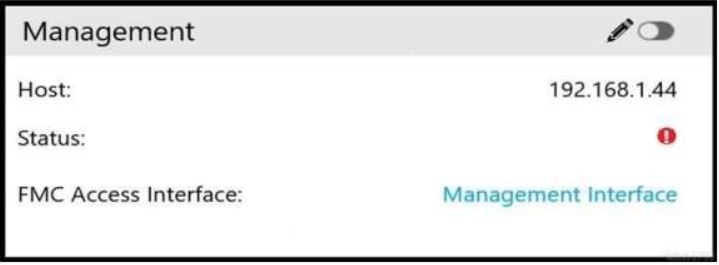
FMC_FTD_Connection.jpg

Is the effect of the existing Cisco FMC configuration?

A. The remote management port for communication between the Cisco FMC and the managed device changes to port 8443.
B. The managed device is deleted from the Cisco FMC.
C. The SSL-encrypted communication channel between the Cisco FMC and the managed device becomes plain-text communication channel.
D. The management connection between the Cisco FMC and the Cisco FTD is disabled.


Answer: D

Question 60

An engineer is working on a LAN switch and has noticed that its network connection to the mime Cisco IPS has gone down. Upon troubleshooting it is determined that the switch is working as expected. What must have been implemented for this failure to occur?

A. The upstream router has a misconfigured routing protocol
B. Link-state propagation is enabled
C. The Cisco IPS has been configured to be in fail-open mode
D. The Cisco IPS is configured in detection mode


Answer: B

Question 61

An engineer must define a URL object on Cisco FMC. What is the correct method to specify the URL without performing SSL inspection?

A. Use Subject Common Name value.
B. Specify all subdomains in the object group.
C. Specify the protocol in the object.
D. Include all URLs from CRL Distribution Points.


Answer: A

Question 62

An administrator is creating interface objects to better segment their network but is having trouble adding interfaces to the objects. What is the reason for this failure?

A. The interfaces are being used for NAT for multiple networks.
B. The administrator is adding interfaces of multiple types.
C. The administrator is adding an interface that is in multiple zones.
D. The interfaces belong to multiple interface groups.


Answer: B

Question 63

What is an advantage of adding multiple inline interface pairs to the same inline interface set when deploying an asynchronous routing configuration?

A. Allows the IPS to identify inbound and outbound traffic as part of the same traffic flow.
B. The interfaces disable autonegotiation and interface speed is hard coded set to 1000 Mbps.
C. Allows traffic inspection to continue without interruption during the Snort process restart.
D. The interfaces are automatically configured as a media-independent interface crossover.


Answer: A

Question 64

Which firewall design allows a firewall to forward traffic at layer 2 and layer 3 for the same subnet?

A. Cisco Firepower Threat Defense mode
B. transparent mode
C. routed mode
D. integrated routing and bridging


Answer: D

Question 65

Which feature is supported by IRB on Cisco FTD devices?

A. redundant interface
B. dynamic routing protocol
C. EtherChannel interface
D. high-availability cluster


Answer: A

Explanation

From this Cisco link:

With Integrated Routing and Bridging, you can use a “bridge group” where you group together multiple interfaces on a network, and the FTD device uses bridging techniques to pass traffic between the interfaces.

And in the “Unsupported Features for Bridge Groups in Routed Mode” section:

“Only physical interfaces, redundant interfaces, and subinterfaces are supported as bridge group member interfaces.” -> Answer A is correct.

Also in the “Unsupported Features in Routed Mode” section, “EtherChannel member interfaces” and “Clustering” are not supported -> Answer C and answer D are not correct.

In both “Unsupported Features in Transparent Mode” and “Unsupported Features in Routed Mode” sections, the “Dynamic routing protocols” is not supported -> Answer B is not correct.

Question 66

A network administrator is configuring a Cisco AMP public cloud instance and wants to capture infections and polymorphic variants of a threat to help detect families of malware. Which detection engine meets this requirement?

A. RBAC
B. Tetra
C. Ethos
D. Spero


Answer: C

Question 67

Which Cisco AMP for Endpoints policy is used only for monitoring endpoint actively?

A. Windows domain controller
B. audit
C. triage
D. protection


Answer: B

Question 68

Which two actions can be used in an access control policy rule? (Choose two.)

A. Block with Reset
B. Monitor
C. Analyze
D. Discover
E. Block ALL


Answer: A B

Question 69

An organization has a Cisco FTD that uses bridge groups to pass traffic from the inside interfaces to the outside interfaces. They are unable to gather information about neighbouring Cisco devices or use multicast in their environment. What must be done to resolve this issue?

A. Create a firewall rule to allow CDP traffic.
B. Create a bridge group with the firewall interfaces.
C. Change the firewall mode to transparent.
D. Change the firewall mode to routed.


Answer: C

Explanation

Bridge Groups in Routed Firewall Mode

In routed firewall mode, broadcast and multicast traffic is blocked even if you allow it in an access rule, including unsupported dynamic routing protocols and DHCP (unless you configure DHCP relay). Within a bridge group, you can allow this traffic with an access rule (using an extended ACL) -> Answer D is not correct.

Reference: https://www.cisco.com/c/en/us/td/docs/security/asa/asa913/configuration/general/asa-913-general-config/intro-fw.html

According to the question, we learn that this organization used bridge groups already -> Answer B is not correct.

Answer A seems to be not correct as the firewall rule only allows CDP traffic, not multicast traffic. So only answer C is left.

Note: Bridge groups are supported in both transparent and routed firewall mode.

Question 70

A network administrator cannot select the link to be used for failover when configuring an active/passive HA Cisco FTD pair. Which configuration must be changed before setting up the high availability pair?

A. An IP address in the same subnet must be added to each Cisco FTD on the interface.
B. The interface name must be removed from the interface on each Cisco FTD.
C. The name Failover must be configured manually on the interface on each Cisco FTD.
D. The interface must be configured as part of a LACP Active/Active EtherChannel.


Answer: B

Question 71

A company wants a solution to aggregate the capacity of two Cisco FTD devices to make the best use of resources such as bandwidth and connections per second. Which order of steps must be taken across theCisco FTDs with Cisco FMC to meet this requirement?

A. Add members to the Cisco FMC, configure Cisco FTD interfaces, create the cluster in Cisco FMC, and configure cluster members in Cisco FMC
B. Add members to Cisco FMC, configure Cisco FTD interfaces in Cisco FMC, configure cluster members in Cisco FMC, create cluster in Cisco FMC, and configure cluster members in Cisco FMC
C. Configure the Cisco FTD interfaces, add members to FMC, configure cluster members in FMC, and create cluster in Cisco FMC
D. Configure the Cisco FTD interfaces and cluster members, add members to Cisco FMC, and create the cluster in Cisco FMC


Answer: D

Question 72

An administrator is configuring their transparent Cisco FTD device to receive ERSPAN traffic from multiple switches on a passive port, but the Cisco FTD is not processing the traffic. What is the problem?

A. The switches do not have Layer 3 connectivity to the FTD device for GRE traffic transmission.
B. The switches were not set up with a monitor session ID that matches the flow ID defined on the Cisco FTD.
C. The Cisco FTD must be in routed mode to process ERSPAN traffic.
D. The Cisco FTD must be configured with an ERSPAN port not a passive port.


Answer: C

Question 73

The administrator notices that there is malware present with an .exe extension and needs to verify if any of the systems on the network are running the executable file. What must be configured within Cisco AMP for Endpoints to show this data?

A. vulnerable software
B. file analysis
C. threat root cause
D. prevalence


Answer: D

Question 74

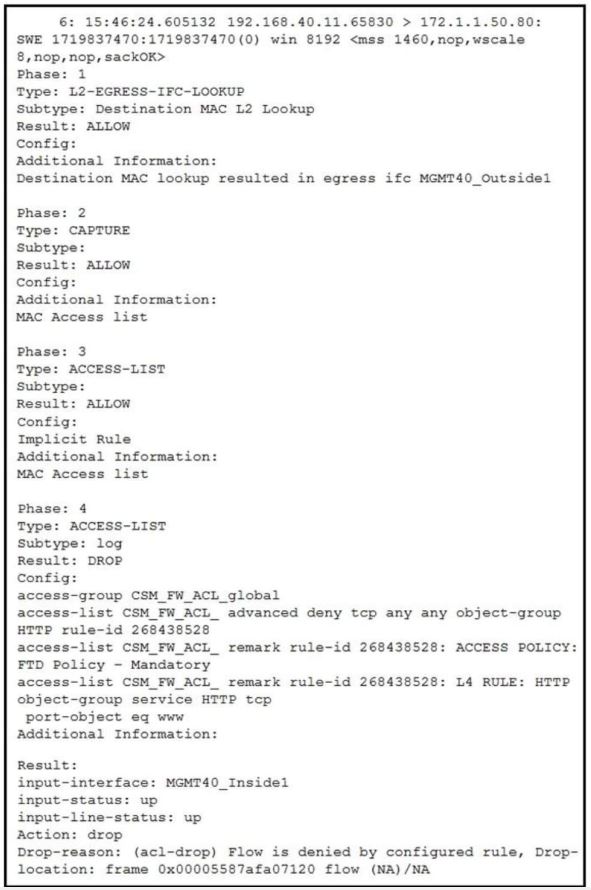
Refer the exhibit.
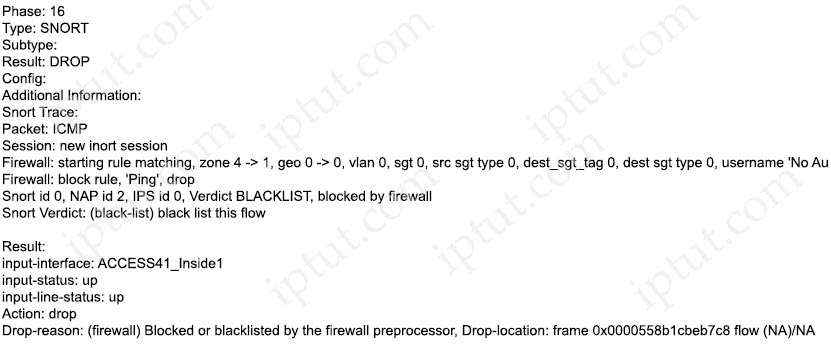
Snort_Verdict.jpg

A systems administrator conducts a connectivity test to their SCCM server from a host machine and gets no response from the server. Which action ensures that the ping packets reach the destination and that the host receives replies?

A. Modify the Snort rules to allow ICMP traffic
B. Create an access control policy rule that allows ICMP traffic
C. Configure a custom Snort signature to allow ICMP traffic after inspection
D. Create an ICMP allow list and add the ICMP destination to remove it from the implicit deny list


Answer: D

Question 75

The network administrator wants to enhance the network security posture by enabling machine learning tor malware detection due to a concern with suspicious Microsoft executable file types that were seen while creating monthly security reports for the CIO. Which feature must be enabled to accomplish this goal?

A. Spero
B. dynamic analysis
C. static analysis
D. Ethos


Answer: A
SNCF Questions – Part 2

September 30th, 2022

Question 1

Which CLI command is used to control special handling of ClientHello messages?

A. system support ssl-client-hello-tuning
B. system support ssl-client-hello-display
C. system support ssl-client-hello-force-reset
D. system support ssl-client-hello-reset


Answer: A

Explanation

In fact there is no correct answer in this question, the correct answer should be “system support ssl-client-hello-enabled” which controls all special handling of ClientHello messages.

Reference: https://www.cisco.com/c/en/us/td/docs/security/firepower/640/configuration/guide/fpmc-config-guide-v64/classic_device_command_line_reference.html

But we have to choose one best answer then “system support ssl-client-hello-tuning” is the best choice. It allows you to refine how the managed device modifies ClientHello messages during SSL handshakes. This command tunes the default lists of cipher suites, elliptic curves, and extensions that the system allows in ClientHello messages.

Question 2

Which command is typed at the CLI on the primary Cisco FTD unit to temporarily stop running high-availability?

A. configure high-availability resume
B. configure high-availability disable
C. system support network-options
D. configure high-availability suspend


Answer: D

Explanation

We only want to “temporarily” stop so the keyword must be “suspend”, not “disable” (which breaks the high availability connection permanently).

Question 3

Which command must be run to generate troubleshooting files on an FTD?

A. system support view-files
B. sudo sf_troubleshoot.pl
C. system generate-troubleshoot all
D. show tech-support


Answer: C

Question 4

When do you need the file-size command option during troubleshooting with packet capture?

A. when capture packets are less than 16 MB
B. when capture packets are restricted from the secondary memory
C. when capture packets exceed 10 GB
D. when capture packets exceed 32 MB


Answer: D

Question 5

What is a functionality of port objects in Cisco FMC?

A. to mix transport protocols when setting both source and destination port conditions in a rule
B. to represent protocols other than TCP, UDP, and ICMP
C. to represent all protocols in the same way
D. to add any protocol other than TCP or UDP for source port conditions in access control rules.


Answer: B

Question 6

Within Cisco Firepower Management Center, where does a user add or modify widgets?

A. dashboard
B. reporting
C. context explorer
D. summary tool


Answer: A

Question 7

A network engineer is configuring URL Filtering on Firepower Threat Defense. Which two port requirements on the Firepower Management Center must be validated to allow communication with the cloud service? (Choose two)

A. outbound port TCP/443
B. inbound port TCP/80
C. outbound port TCP/8080
D. inbound port TCP/443
E. outbound port TCP/80


Answer: A E

Question 8

What is a behavior of a Cisco FMC database purge?

A. User login and history data are removed from the database if the User Activity check box is selected.
B. Data can be recovered from the device.
C. The appropriate process is restarted.
D. The specified data is removed from Cisco FMC and kept for two weeks.


Answer: C

Question 9

Which two packet captures does the FTD LINA engine support? (Choose two)

A. Layer 7 network ID
B. source IP
C. application ID
D. dynamic firewall importing
E. protocol


Answer: B E

Question 10

Which two features of Cisco AMP for Endpoints allow for an uploaded file to be blocked? (Choose two)

A. application blocking
B. simple custom detection
C. file repository
D. exclusions
E. application whitelisting


Answer: A B

Question 11

Which action should you take when Cisco Threat Response notifies you that AMP has identified a file as malware?

A. Add the malicious file to the block list.
B. Send a snapshot to Cisco for technical support.
C. Forward the result of the investigation to an external threat-analysis engine.
D. Wait for Cisco Threat Response to automatically block the malware.


Answer: A

Question 12

What is a valid Cisco AMP file disposition?

A. non-malicious
B. malware
C. known-good
D. pristine


Answer: B

Question 13

In a Cisco AMP for Networks deployment, which disposition is returned if the cloud cannot be reached?

A. unavailable
B. unknown
C. clean
D. disconnected


Answer: A

Question 14

Which two remediation options are available when Cisco FMC is integrated with Cisco ISE? (Choose two)

A. dynamic null route configured
B. DHCP pool disablement
C. quarantine
D. port shutdown
E. host shutdown


Answer: CD

Question 15

Which connector is used to integrate Cisco ISE with Cisco FMC for Rapid Threat Containment?

A. pxGrid
B. FTD RTC
C. FMC RTC
D. ISEGrid


Answer: A

Question 16

What is the maximum SHA level of filtering that Threat intelligence Director supports?

A. SHA-1024
B. SHA-4096
C. SHA-512
D. SHA-256


Answer: D

Question 17

What is a result of enabling Cisco FTD clustering?

A. For the dynamic routing feature, if the master unit fails, the newly elected master unit maintains all existing connections.
B. integrated Routing and Bridging is supported on the master unit.
C. Site-to-site VPN functionality is limited to the master unit, and all VPN connections are dropped if the master unit fails.
D. All Firepower appliances can support Cisco FTD clustering.


Answer: C

Question 18

Which two conditions are necessary for high availability to function between two Cisco FTD devices? (Choose two)

A. The units must be the same version
B. Both devices can be part of a different group that must be in the same domain when configured within the FMC.
C. The units must be different models if they are part of the same series.
D. The units must be configured only for firewall routed mode.
E. The units must be the same model.


Answer: A E

Question 19

On the advanced tab under inline set properties, which allows interfaces to emulate a passive interface?

A. transparent inline mode
B. TAP mode
C. strict TCP enforcement
D. propagate link state


Answer: B

Question 20

Which two deployment types support high availability? (Choose two)

A. transparent
B. routed
C. clustered
D. intra-chassis multi-instance
E. virtual appliance in public cloud


Answer: A B

Question 21

What are 2 types or forms of suppression on a FirePower policy (or FTD)? (Choose two)

A. source
B. port
C. rule
D. protocol
E. application


Answer: A C

Question 22

Which protocol establishes network redundancy in a switched Firepower device deployment?

A. STP
B. HSRP
C. GLBP
D. VRRP


Answer: A

Question 23

Which Cisco Firepower Threat Defense, which two interface settings are required when configuring a routed interface? (Choose two)

A. Redundant interface
B. EtherChannel
C. Speed
D. Media Type
E. Duplex


Answer: CE

Question 24

Which two dynamic routing protocols are supported in Firepower Threat Defense without using FlexConfig? (Choose two)

A. EIGRP
B. OSPF
C. static routing
D. IS-IS
E. BGP


Answer: B E

Explanation

Both OSPF and BGP can be configured with Smart CLI without FlexConfig

Reference: https://www.cisco.com/c/en/us/td/docs/security/firepower/660/fdm/fptd-fdm-config-guide-660/fptd-fdmrouting.html

Question 25

Which two OSPF routing features are configured in Cisco FMC and propagated to Cisco FTD? (Choose two)

A. OSPFv2 with iPv6 capabilities
B. virtual links
C. SHA authentication to OSPF packets
D. area boundary router type 1 LSA filtering
E. MD5 authentication to OSPF packets


Answer: B E

Question 26

What Software can be installed on the Cisco 4100 series appliance? (Choose two)

A. FTD
B. ASA
C. ASAv
D. FMC


Answer: A B

Question 27

Which two field can be used to create a new email alert within the Cisco Firepower Management center under Policies > Actions > Alerts tab? (Choose two)

A. Device
B. Source
C. Destination
D. From
E. Relay Host


Answer: D E

Question 28

When creating a report template, how can the results be limited to show only the activity of a specific subnet?

A. Create a custom search in Firepower Management Center and select it in each section of the report.
B. Add an input Parameter in the Advanced Settings of the report, and set the type to Network/IP.
C. Add a Table View section to the report with the Search field defined as the network in CIDR format.
D. Select IP Address as the X-Axis in each section of the report.


Answer: B

Question 29

What is the disadvantage of setting up a site-to-site VPN in a clustered-units environment?

A. VPN connections can be re-established only if the failed master unit recovers.
B. Smart License is required to maintain VPN connections simultaneously across all cluster units.
C. VPN connections must be re-established when a new master unit is elected.
D. Only established VPN connections are maintained when a new master unit is elected.


Answer: C

Question 30

Which two routing options are valid with Cisco Firepower Threat Defense? (Choose two)

A. BGPv6
B. ECMP with up to three equal cost paths across multiple interfaces
C. ECMP with up to three equal cost paths across a single interface
D. BGPv4 in transparent firewall mode
E. BGPv4 with nonstop forwarding


Answer: A C

Explanation

You can have up to 8 equal cost static or dynamic routes per interface (-> Answer C is correct). For example, you can configure multiple default routes on the outside interface that specify different gateways.

route for 0.0.0.0 0.0.0.0 through outside to 10.1.1.2
route for 0.0.0.0 0.0.0.0 through outside to 10.1.1.3
route for 0.0.0.0 0.0.0.0 through outside to 10.1.1.4

In this case, traffic is load-balanced on the outside interface between 10.1.1.2, 10.1.1.3, and 10.1.1.4. Traffic is distributed among the specified gateways based on an algorithm that hashes the source and destination IP addresses, incoming interface, protocol, source and destination ports.

Reference: https://www.cisco.com/c/en/us/td/docs/security/firepower/70/fdm/fptd-fdm-config-guide-700/fptd-fdm-routing.html

Cisco Firepower Threat Defense Configuration Guide for Firepower Device Manager, Version 6.6

BGP can also be used for carrying routing information for IPv6 prefix over IPv6 networks. -> Answer A is correct.

Reference: https://www.cisco.com/c/en/us/td/docs/security/firepower/660/fdm/fptd-fdm-config-guide-660/fptd-fdm-bgp.html

Question 31

Which description of a correlation, policy configuration in the Cisco Firepower Management Center, is true?

A. Correlation policy priorities override whitelist priorities.
B. The system displays correlation policies that are created on all of the domains in a multidomain deployment.
C. You cannot add a host profile qualification to a correlation rule that is triggered by a malware event.
D. Deleting a response group deletes the responses of that group.


Answer: C

Question 32

Which two TCP ports can allow the Cisco Firepower Management Center to communication with FireAMP cloud for file disposition information? (Choose two)

A. 8080
B. 22
C. 8305
D. 32137
E. 443


Answer: D E

Question 33

Which object type supports object overrides?

A. time range
B. security group tag
C. network object
D. DNS server group


Answer: C

Question 34

Which Cisco Firepower rule action displays an HTTP warning page?

A. Monitor
B. Block
C. interactive Block
D. Allow with Warning


Answer: C

Question 35

What is the result of specifying of QoS rule that has a rate limit that is greater than the maximum throughput of an interface?

A. The rate-limiting rule is disabled.
B. Matching traffic is not rate limited.
C. The system rate-limits all traffic.
D. The system repeatedly generates warnings.


Answer: B

Question 36

Which Firepower feature allows users to configure bridges in routed mode and enables devices to perform Layer 2 switching between interfaces?

A. FlexConfig
B. BDI
C. SGT
D. iRB


Answer: D

Question 37

In which two places can thresholding settings be configured? (Choose two)

A. on each IPS rule
B. globally, within the network analysis policy
C. globally, per intrusion policy
D. on each access control rule
E. per preprocessor, within the network analysis policy


Answer: A C

Question 38

In which two ways do access control policies operate on a Cisco Firepower system? (Choose two)

A. Traffic inspection can be interrupted temporarily when configuration changes are deployed.
B. The system performs intrusion inspection followed by file inspection.
C. They can block traffic based on Security intelligence data.
D. File policies use an associated variable set to perform intrusion prevention.
E. The system performs a preliminary inspection on trusted traffic to validate that it matches the trusted parameters.


Answer: A C

Question 39

Which function is the primary function of Cisco AMP threat Grid?

A. automated email encryption
B. applying a real-time URI blacklist
C. automated malware analysis
D. monitoring network traffic


Answer: C

Question 40

Which are two features of Cisco Trust Anchor? (Choose two)

A. flood attack detection
B. secure boot
C. image signing
D. DDoS mitigation
E. SYN flood detection


Answer: B C

Explanation

Cisco Trust Anchor Technologies provide a highly secure foundation for certain Cisco products. They enable hardware and software authenticity assurance for supply chain trust and strong mitigation against a man-in-the-middle compromise of software and firmware. Trust Anchor capabilities include:

+ Image signing: Cryptographically signed images provide assurance that the firmware, BIOS, and other software are authentic and unmodified. As the system boots, the system’s software signatures are checked for integrity.

+ Secure Boot: Secure Boot anchors the boot sequence chain of trust to immutable hardware, mitigating threats against a system’s foundational state and the software that is to be loaded, regardless of a user’s privilege level. It provides layered protection against the persistence of illicitly modified firmware.

+ Trust Anchor module: A tamper-resistant, strong-cryptographic, single-chip solution provides hardware authenticity assurance to uniquely identify the product so that its origin can be confirmed to Cisco, providing assurance that the product is genuine.

Reference: https://www.secureitstore.com.au/Firepower-4110.asp

Question 41

Which two types of objects are reusable and supported by Cisco FMC? (Choose two)

A. dynamic key mapping objects that help link HTTP and HTTPS GET requests to Layer 7 application protocols.
B. reputation-based objects that represent Security intelligence feeds and lists, application filters based on category and reputation, and file lists
C. network-based objects that represent IP address and networks, port/protocols pairs, VLAN tags, security zones, and origin/destination country
D. network-based objects that represent FQDN mappings and networks, port/protocol pairs, VXLAN tags, security zones and origin/destination country
E. reputation-based objects, such as URL categories


Answer: B C

https://www.cisco.com/c/en/us/td/docs/security/firepower/620/configuration/guide/fpmc-config- guide-v62/
reusable_objects.html#ID-2243-00000414

Question 42

What is the benefit of selecting the trace option for packet capture?

A. The option indicates whether the packet was dropped or successful.
B. The option indicated whether the destination host responds through a different path.
C. The option limits the number of packets that are captured.
D. The option captures details of each packet.


Answer: A

Question 43

After deploying a network-monitoring tool to manage and monitor networking devices in your organization, you realize that you need to manually upload an MIB for the Cisco FMC. in which folder should you upload the MIB file?

A. /etc/sf/DCMIB.ALERT
B. /sf/etc/DCEALERT.MIB
C. /etc/sf/DCEALERT.MIB
D. system/etc/DCEALERT.MIB


Answer: C

https://www.cisco.com/c/en/us/td/docs/security/firesight/541/firepower-module-user-guide/asa- firepowermodule-user-guide-v541/Intrusion-External-Responses.pdf

Question 44

Which command is run at the CLI when logged in to an FTD unit, to determine whether the unit is managed locally or by a remote FMC server?

A. system generate-troubleshoot
B. show configuration session
C. show managers
D. show running-config | include manager


Answer: C

https://www.cisco.com/c/en/us/td/docs/security/firepower/command_ref/b_Command_Reference_for_Firepower_Threat_Defense/c_3.html

Question 45

Which command should be used on the Cisco FTD CLI to capture all the packets that hit an interface?

A. configure coredump packet-engine enable
B. capture-traffic
C. capture
D. capture WORD


Answer: D

Question 46

How many report templates does the Cisco Firepower Management Center support?

A. 20
B. 10
C. 5
D. unlimited


Answer: D

https://www.cisco.com/c/en/us/td/docs/security/firepower/60/configuration/guide/fpmc-config- guide-v60/Working_with_Reports.html

Question 47

Which action should be taken after editing an object that is used inside an access control policy?

A. Delete the existing object in use.
B. Refresh the Cisco FMC GUI for the access control policy.
C. Redeploy the updated configuration.
D. Create another rule using a different object name.


Answer: C

https://www.cisco.com/c/en/us/td/docs/security/firepower/630/configuration/guide/fpmc-config- guide-v63/reusable_objects.html

Question 48

Which two characteristics represent a Cisco device operating in tap mode? (Choose two)

A. It analyzes copies of packets from the packet flow
B. The device is deployed in a passive configuration
C. If a rule is triggered the device generates an intrusion event.
D. The packet flow traverses the device
E. If a rule is triggered the device drops the packet


Answer: A B

Explanation

With tap mode, the device is deployed inline, but instead of the packet flow passing through the device, a copy of each packet is sent to the device and the network traffic flow is undisturbed. The copy of traffic will be inspected -> Answer A is correct.

Answer B is correct as the device monitors traffic without being inline and if the device fails, traffic is unaffected (passive configuration).

Although answer C is correct but it does not unique to tap mode. Inline mode also generates events.

Question 49

When using Cisco AMP for Networks, which feature copies a file to the Cisco AMP cloud for analysis?

A. Spero analysis
B. dynamic analysis
C. sandbox analysis
D. malware analysis


Answer: B

Question 50

Which report template field format is available in Cisco FMC?

A. box lever chart
B. arrow chart
C. bar chart
D. benchmark chart


Answer: C

https://www.cisco.com/c/en/us/td/docs/security/firepower/60/configuration/guide/fpmc-config- guide-v60/Working_with_Reports.html

Question 51

Which group within Cisco does the Threat Response team use for threat analysis and research?

A. Cisco Deep Analytics
B. OpenDNS Group
C. Cisco Network Response
D. Cisco Talos


Answer: D

https://www.cisco.com/c/en/us/products/security/threat-response.html#~benefits

Question 52

Which CLI command is used to generate firewall debug messages on a Cisco Firepower?

A. system support firewall-engine-debug
B. system support ssl-debug
C. system support platform
D. system support dump-table


Answer: A

https://www.cisco.com/c/en/us/support/docs/security/firepower-ngfw/212330-firepower- management-centerdisplay-acc.html

Question 53

Which command-line mode is supported from the Cisco Firepower Management Center CLI?

A. privileged
B. user
C. configuration
D. admin


Answer: C

https://www.cisco.com/c/en/us/td/docs/security/firepower/660/configuration/guide/fpmc-config- guide-v66/command_line_reference.pdf

Question 54

Which command is entered in the Cisco FMC CLI to generate a troubleshooting file?

A. show running-config
B. show tech-support chassis
C. system support diagnostic-cli
D. sudo sf_troubleshoot.pl

Answer: D

https://www.cisco.com/c/en/us/support/docs/security/sourcefire-defense-center/117663-technote- SourceFire-00.html

Question 55

With Cisco FTD integrated routing and bridging, which interface does the bridge group use to communicate with a routed interface?

A. switch virtual
B. bridge group member
C. bridge virtual
D. subinterface


Answer: C

Question 56

A network engineer is extending a user segment through an FTD device for traffic inspection without creating another IP subnet. How is this accomplished on an FTD device in routed mode?

A. by leveraging the ARP to direct traffic through the firewall
B. by assigning an inline set interface
C. by using a BVI and create a BVI IP address in the same subnet as the user segment
D. by bypassing protocol inspection by leveraging pre-filter rules


Answer: C

https://www.cisco.com/c/en/us/td/docs/security/firepower/640/configuration/guide/fpmc-config- guide-v64/
transparent_or_routed_firewall_mode_for_firepower_threat_defense.html

Question 57

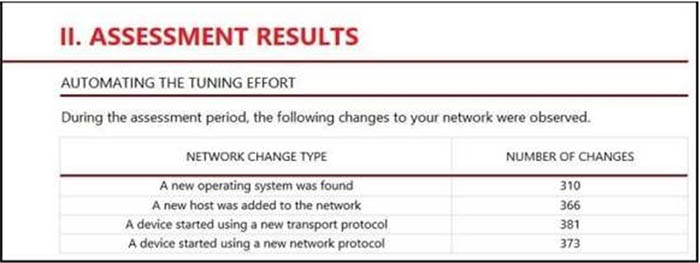
Refer to the exhibit.

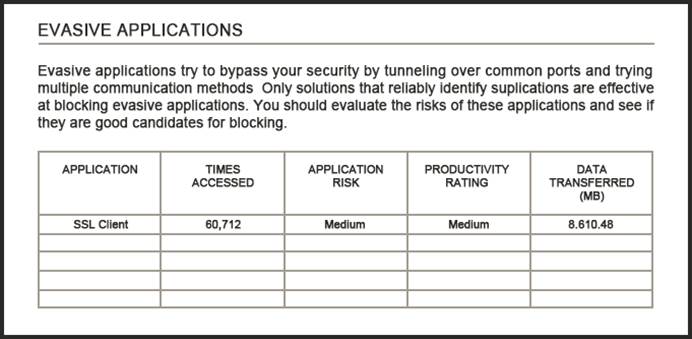
Attacks_Risk_Report.jpg

An engineer is analyzing the Attacks Risk Report and finds that there are over 300 instances of new operating systems being seen on the network. How is the Firepower configuration updated to protect these new operating systems?

A. Cisco Firepower automatically updates the policies.
B. The administrator requests a Remediation Recommendation Report from Cisco Firepower
C. Cisco Firepower gives recommendations to update the policies.
D. The administrator manually updates the policies.


Answer: C

Question 58

A security engineer is configuring an Access Control Policy for multiple branch locations. These locations share a common rule set and utilize a network object called INSIDE_NET which contains the locally significant internal network subnets at each location. What technique will retain the policy consistency at each location but allow only the locally significant network subnet within the applicable rules?

A. utilizing policy inheritance
B. utilizing a dynamic Access Control Policy that updates from Cisco Talos
C. creating a unique Access Control Policy per device
D. creating an Access Control Policy with an INSIDE_NET network object and object overrides


Answer: D

Question 59

An administrator is working on a migration from Cisco ASA to the Cisco FTD appliance and needs to test the rules without disrupting the traffic. Which policy type should be used to configure the ASA rules during this phase of the migration?

A. identity
B. intrusion
C. Access Control
D. Prefilter


Answer: D

https://www.cisco.com/c/en/us/td/docs/security/firepower/migration-tool/migration- guide/ASA2FTD-with-FPMigration-Tool/b_Migration_Guide_ASA2FTD_chapter_01011.html

Question 60

An engineer currently has a Cisco FTD device registered to the Cisco FMC and is assigned the address of 10 10.50.12. The organization is upgrading the addressing schemes and there is a requirement to convert the addresses to a format that provides an adequate amount of addresses on the network. What should the engineer do to ensure that the new addressing takes effect and can be used for the Cisco FTD to Cisco FMC connection?

A. Delete and reregister the device to Cisco FMC
B. Update the IP addresses from iFV4 to iPv6 without deleting the device from Cisco FMC
C. Format and reregister the device to Cisco FMC.
D. Cisco FMC does not support devices that use iPv4 IP addresses.


Answer: A

Question 61

After using Firepower for some time and learning about how it interacts with the network, an administrator is trying to correlate malicious activity with a user. Which widget should be configured to provide this visibility on the Cisco Firepower dashboards?

A. Custom Analysis
B. Current Status
C. Current Sessions
D. Correlation Events


Answer: A

Explanation

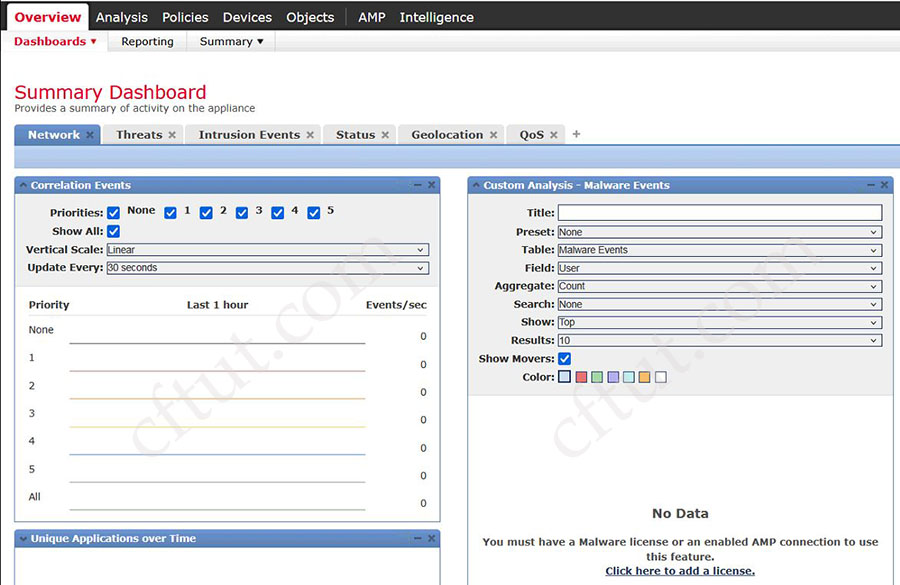
Here are the “Correlation Events” and “Custom Analysis” widgets:

FTD_correlation_custom_analysis_widgets_3.jpg

As we can see, in the “Correlation Events” we cannot check per user. But in “Custom Analysis” widget we can choose the “User” field in “Malware Events” table.

Note: Unfortunately we don’t have a Malware license to display this “Custom Analysis” widget.

Question 62

An administrator is attempting to remotely log into a switch in the data centre using SSH and is unable to connect. How does the administrator confirm that traffic is reaching the firewall?

A. by running Wireshark on the administrator’s PC
B. by performing a packet capture on the firewall.
C. by running a packet tracer on the firewall.
D. by attempting to access it from a different workstation.


Answer: B

https://www.cisco.com/c/en/us/support/docs/security/firepower-ngfw/212474-working-with- firepower-threatdefense-f.html#anc16

Question 63

An engineer is configuring a second Cisco FMC as a standby device but is unable to register with the active unit. What is causing this issue?

A. The primary FMC currently has devices connected to it.
B. The code versions running on the Cisco FMC devices are different
C. The licensing purchased does not include high availability
D. There is only 10 Mbps of bandwidth between the two devices.


Answer: B

https://www.cisco.com/c/en/us/td/docs/security/firepower/620/configuration/guide/fpmc-config- guide-v62/firepower_management_center_high_availability.html

Question 64

The event dashboard within the Cisco FMC has been inundated with low priority intrusion drop events, which are overshadowing high priority events. An engineer has been tasked with reviewing the policies and reducing the low priority events. Which action should be configured to accomplish this task?

A. generate events
B. drop packet
C. drop connection
D. drop and generate


Answer: B

Explanation

Within the packet view of an intrusion event, you can take several actions on the rule that triggered the event.

Drop packets — Click Set this rule to drop the triggering packet

Reference: https://www.cisco.com/c/en/us/td/docs/security/firepower/620/configuration/guide/fpmc-config-guide-v62/working_with_intrusion_events.html

Question 65

An engineer is implementing Cisco FTD in the network and is determining which Firepower mode to use. The organization needs to have multiple virtual Firepower devices working separately inside of the FTD appliance to provide traffic segmentation. Which deployment mode should be configured in the Cisco Firepower Management Console to support these requirements?

A. multiple deployment
B. single-context
C. single deployment
D. multi-instance


Answer: D

Question 66

An engineer is configuring a cisco FTD appliance in iPS-only mode and needs to utilize fail- to- wire interfaces. Which interface mode should be used to meet these requirements?

A. transparent
B. routed
C. passive
D. inline set


Answer: D

https://www.cisco.com/c/en/us/td/docs/security/firepower/630/configuration/guide/fpmc-config- guide-v63/inline_sets_and_passive_interfaces_for_firepower_threat_defense.html

Question 67

An engineer is troubleshooting application failures through a FTD deployment. While using the FMC CLI, it has been determined that the traffic in QoS not matching the desired policy. What should be done to correct this?

A. Use the system support firewall-engine-debug command to determine which rules the traffic matching and modify the rule accordingly
B. Use the system support application-identification-debug command to determine which rules the traffic matching and modify the rule accordingly
C. Use the system support firewall-engine-dump-user-f density-data command to change the policy and allow the application through the firewall.
D. Use the system support network-options command to fine tune the policy.


Answer: A

Question 68

An engineer has been asked to show application usages automatically on a monthly basis and send the information to management. What mechanism should be used to accomplish this task?

A. event viewer
B. reports
C. dashboards
D. context explorer


Answer: B

Question 69

An organization has noticed that malware was downloaded from a website that does not currently have a known bad reputation. How will this issue be addresses globally in the quickest way possible and with the least amount of impact?

A. by denying outbound web access
B. Cisco Talos will automatically update the policies.
C. by isolating the endpoint
D. by creating a URL object in the policy to block the website


Answer: D

Explanation

This question is unclear as:

+ “in the quickest way possible”: block the website in the policy is the quickest way to solve as it takes effect immediately. We don’t have to wait for Talos to update while malware may continue coming to our organization -> Answer D is correct.

+ “be addresses globally”: not sure if “globally” in the organization or in the world. If it is “in the world” then answer B is correct. If it is “in the organization” only, then along with above explanation, answer D is the best choice.
+ “least amount of impact”: this makes answer A and answer C not correct.

In practical, the best solution is answer D as we must block the malware immediately. Talos will not rely on our malware report solely to update its database and it may take long time for Talos to block that website -> Answer D is the best choice.

Question 70

An organization has implemented Cisco Firepower without IPS capabilities and now wants to enable inspection for their traffic. They need to be able to detect protocol anomalies and utilize the Snort rule sets to detect malicious behavior. How is this accomplished?

A. Modify the network discovery policy to detect new hosts to inspect.
B. Modify the access control policy to redirect interesting traffic to the engine.
C. Modify the intrusion policy to determine the minimum severity of an event to inspect.
D. Modify the network analysis policy to process the packets for inspection.


Answer: B

https://www.cisco.com/c/en/us/td/docs/security/firepower/670/fdm/fptd-fdm-config-guide-670/fptdfdmintrusion.html

Question 71

A hospital network needs to upgrade their Cisco FMC managed devices and needs to ensure that a disaster recovery process is in place. What must be done in order to minimize downtime on the network?

A. Configure a second circuit to an ISP for added redundancy
B. Keep a copy of the current configuration to use as backup
C. Configure the Cisco FMCs for failover
D. Configure the Cisco FMC managed devices for clustering.


Answer: B

Question 72

An engineer is monitoring network traffic from their sales and product development departments, which are on two separate networks. What must be configured in order to maintain data privacy for both departments?

A. Use a dedicated IPS inline set for each department to maintain traffic separation
B. Use 802 1Q mime set Trunk interfaces with VLANs to maintain logical traffic separation
C. Use passive IDS ports for both departments
D. Use one pair of inline set in TAP mode for both departments


Answer: A

https://www.cisco.com/c/en/us/td/docs/security/firepower/640/configuration/guide/fpmc-config- guide-v64/inline_sets_and_passive_interfaces_for_firepower_threat_defense.html

Question 73

A Cisco FTD device is running in transparent firewall mode with a VTEP bridge group member ingress interface. What must be considered by an engineer tasked with specifying a destination MAC address for a packet trace?

A. The destination MAC address is optional if a VLAN ID value is entered
B. Only the UDP packet type is supported
C. The output format option for the packet logs unavailable
D. The VLAN ID and destination MAC address are optional


Answer: A

Explanation

https://www.cisco.com/c/en/us/td/docs/security/firepower/620/configuration/guide/fpmc-config- guide-v62/troubleshooting_the_system.html

Question 74

What is a characteristic of bridge groups on a Cisco FTD?

A. in routed firewall mode, routing between bridge groups must pass through a routed interface.
B. in routed firewall mode, routing between bridge groups is supported.
C. in transparent firewall mode, routing between bridge groups is supported
D. Routing between bridge groups is achieved only with a router-on-a-stick configuration on a connected router


Answer: C (?)

Explanation

A bridge group is a group of interfaces that the FTD device bridges instead of routes. Bridge groups are only supported in Transparent Firewall Mode.

Reference: https://www.cisco.com/c/en/us/td/docs/security/firepower/601/configuration/guide/fpmc-config-guide-v601/fpmc-config-guide-v601_chapter_01101010.html

But in FTD v7.0 Cisco says:

A bridge group is a group of interfaces that the FTD device bridges instead of routes. Bridge groups are supported in both transparent and routed firewall mode

Reference: https://www.cisco.com/c/en/us/td/docs/security/firepower/70/configuration/guide/fpmc-config-guide-v70/transparent_or_routed_firewall_mode_for_firepower_threat_defense.html?bookSearch=true#id_37129

We are not sure which version of FTD this question wants to ask.

Question 75 (duplicated so we removed it)

Question 76

An organization has a compliance requirement to protect servers from clients, however, the clients and servers all reside on the same Layer 3 network. Without readdressing IP subnets for clients or servers, how is segmentation achieved?

A. Deploy a firewall in transparent mode between the clients and servers.
B. Change the IP addresses of the clients, while remaining on the same subnet.
C. Deploy a firewall in routed mode between the clients and servers
D. Change the IP addresses of the servers, while remaining on the same subnet


Answer: A

Question 77

In a multi-tenant deployment where multiple domains are in use, which update should be applied outside of the Global Domain?

A. minor upgrade
B. local import of intrusion rules
C. Cisco Geolocation Database
D. local import of major upgrade


Answer: B

Question 78

A mid-sized company is experiencing higher network bandwidth utilization due to a recent acquisition. The network operations team is asked to scale up their one Cisco FTD appliance deployment to higher capacities due to the increased network bandwidth. Which design option should be used to accomplish this goal?

A. Deploy multiple Cisco FTD appliances in firewall clustering mode to increase performance.
B. Deploy multiple Cisco FTD appliances using VPN load-balancing to scale performance.
C. Deploy multiple Cisco FTD HA pairs to increase performance
D. Deploy multiple Cisco FTD HA pairs in clustering mode to increase performance


Answer: A

Explanation

https://www.cisco.com/c/en/us/td/docs/security/firepower/fxos/clustering/ftd-clustersolution.html#concept_C8502505F840451C9E600F1EED9BC18E

Question 79

An organization has seen a lot of traffic congestion on their links going out to the internet. There is a Cisco Firepower device that processes all of the traffic going to the internet prior to leaving the enterprise. How is the congestion alleviated so that legitimate business traffic reaches the destination?

A. Create a flexconfig policy to use WCCP for application aware bandwidth limiting
B. Create a VPN policy so that direct tunnels are established to the business applications
C. Create a NAT policy so that the Cisco Firepower device does not have to translate as many addresses
D. Create a QoS policy rate-limiting high bandwidth applications


Answer: D

Question 80

An engineer configures an access control rule that deploys file policy configurations to security zone or tunnel zones, and it causes the device to restart. What is the reason for the restart?

A. Source or destination security zones in the access control rule matches the security zones that are associated with interfaces on the target devices.
B. The source tunnel zone in the rule does not match a tunnel zone that is assigned to a tunnel rule in the destination policy.
C. Source or destination security zones in the source tunnel zone do not match the security zones that are associated with interfaces on the target devices.
D. The source tunnel zone in the rule does not match a tunnel zone that is assigned to a tunnel rule in the source policy.


Answer: A

https://www.cisco.com/c/en/us/td/docs/security/firepower/623/configuration/guide/fpmc-config- guide-v623/policy_management.html

Question 81

An engineer is attempting to create a new dashboard within the Cisco FMC to have a single view with widgets from many of the other dashboards. The goal is to have a mixture of threat and security related widgets along with Cisco Firepower device health information. Which two widgets must be configured to provide this information? (Choose two)

A. intrusion Events
B. Correlation information
C. Appliance Status
D. Current Sessions
E. Network Compliance


Answer: AC

https://www.cisco.com/c/en/us/td/docs/security/firepower/640/configuration/guide/fpmc-config- guide-v64/dashboards.html#ID-2206-00000283

Question 82

An organization is setting up two new Cisco FTD devices to replace their current firewalls and cannot have any network downtime. During the setup process, the synchronization between the two devices is failing. What action is needed to resolve this issue?

A. Confirm that both devices have the same port-channel numbering
B. Confirm that both devices are running the same software version
C. Confirm that both devices are configured with the same types of interfaces
D. Confirm that both devices have the same flash memory sizes


Answer: B

Explanation

“cannot have any network downtime” -> configure High Availability (HA).

In order to create an HA between 2 FTD devices, these conditions must be met:
+ Same model
+ Same version – this applies to FXOS and to FTD – major (first number), minor (second number), and maintenance (third number) must be equal.
+ Same number of interfaces
+ Same type of interfaces
+ Both devices as part of the same group/domain in FMC.
+ Have identical Network Time Protocol (NTP) configuration.
+ Be fully deployed on the FMC without uncommitted changes.
+ Be in the same firewall mode: routed or transparent.

Reference: https://www.cisco.com/c/en/us/support/docs/security/firepower-management-center/212699-configure-ftd-high-availability-on-firep.html

Question 83

There is an increased amount of traffic on the network and for compliance reasons, management needs visibility into the encrypted traffic. What is a result of enabling TLS/SSL decryption to allow this visibility?

A. it prompts the need for a corporate managed certificate
B. it has minimal performance impact
C. it is not subject to any Privacy regulations
D. it will fail if certificate pinning is not enforced


Answer: A

Question 84

An organization wants to secure traffic from their branch office to the headquarter building using Cisco Firepower devices, They want to ensure that their Cisco Firepower devices are not wasting resources on inspecting the VPN traffic. What must be done to meet these requirements?

A. Configure the Cisco Firepower devices to ignore the VPN traffic using prefilter policies
B. Enable a flexconfig policy to re-classify VPN traffic so that it no longer appears as interesting traffic
C. Configure the Cisco Firepower devices to bypass the access control policies for VPN traffic.
D. Tune the intrusion policies in order to allow the VPN traffic through without inspection


Answer: C

Explanation

Reference: https://www.cisco.com/c/en/us/td/docs/security/firepower/640/fdm/fptd-fdm-config-guide-640/fptd-fdmravpn.html

Question 85

A network administrator is seeing an unknown verdict for a file detected by Cisco FTD. Which malware policy configuration option must be selected in order to further analyse the file in the Talos cloud?

A. Spero analysis
B. Malware analysis
C. Dynamic analysis
D. Sandbox analysis


Answer: C

Question 86

An engineer has been tasked with providing disaster recovery for an organization’s primary Cisco FMC. What must be done on the primary and secondary Cisco FMCs to ensure that a copy of the original corporate policy is available if the primary Cisco FMC fails?

A. Configure high-availability in both the primary and secondary Cisco FMCs
B. Connect the primary and secondary Cisco FMC devices with Category 6 cables of not more than 10 meters in length.
C. Place the active Cisco FMC device on the same trusted management network as the standby device
D. Restore the primary Cisco FMC backup configuration to the secondary Cisco FMC device when the primary device fails


Answer: A

https://www.cisco.com/c/en/us/td/docs/security/firepower/620/configuration/guide/fpmc-config- guide-v62/firepower_management_center_high_availability.html

Question 87

Refer to the exhibit.

Social_Block.jpg

An organization has an access control rule with the intention of sending all social media traffic for inspection. After using the rule for some time, the administrator notices that the traffic is not being inspected, but is being automatically allowed. What must be done to address this issue?

A. Modify the selected application within the rule
B. Change the intrusion policy to connectivity over security.
C. Modify the rule action from trust to allow
D. Add the social network URLs to the block list


Answer: C

Question 88

A user within an organization opened a malicious file on a workstation which in turn caused a ransomware attack on the network. What should be configured within the Cisco FMC to ensure the file is tested for viruses on a sandbox system?

A. Capacity handling
B. Local malware analysis
C. Spere analysis
D. Dynamic analysis


Answer: D

https://www.cisco.com/c/en/us/td/docs/security/firepower/623/configuration/guide/fpmc-config- guide-v623/file_policies_and_advanced_malware_protection.html#ID-2199-000005d8

Question 89

An engineer configures a network discovery policy on Cisco FMC. Upon configuration, it is noticed that excessive and misleading events filing the database and overloading the Cisco FMC. A monitored NAT device is executing multiple updates of its operating system in a short period of time. What configuration change must be made to alleviate this issue?

A. Leave default networks.
B. Change the method to TCP/SYN.
C. increase the number of entries on the NAT device.
D. Exclude load balancers and NAT devices.


Answer: D

https://www.cisco.com/c/en/us/td/docs/security/firepower/60/configuration/guide/fpmc-config- guide-v60/Network_Discovery_Policies.html

Question 90

A network administrator is configuring SNORT inspection policies and is seeing failed deployment messages in Cisco FMC. What information should the administrator generate for Cisco TAC to help troubleshoot?

A. A Troubleshoot” file for the device in question.
B. A “show tech” file for the device in question
C. A “show tech” for the Cisco FMC.
D. A “troubleshoot” file for the Cisco FMC


Answer: D

https://www.cisco.com/c/en/us/td/docs/security/firepower/620/configuration/guide/fpmc-config- guide-v62/troubleshooting_the_system.html

Question 91

A network engineer is receiving reports of users randomly getting disconnected from their corporate applications which traverses the data center FTD appliance Network monitoring tools show that the FTD appliance utilization is peaking above 90% of total capacity. What must be done in order to further analyze this issue?

A. Use the Packet Export feature to save data onto external drives
B. Use the Packet Capture feature to collect real-time network traffic
C. Use the Packet Tracer feature for traffic policy analysis
D. Use the Packet Analysis feature for capturing network data


Answer: B

https://www.cisco.com/c/en/us/support/docs/security/firepower-ngfw/212474-working-with- firepower-threatdefense-f.html

Question 92

IT management is asking the network engineer to provide high-level summary statistics of the Cisco FTD appliance in the network. The business is approaching a peak season so the need to maintain business uptime is high. Which report type should be used to gather this information?

A. Malware Report
B. Standard Report
C. SNMP Report
D. Risk Report


Answer: D

Question 93

Refer to the exhibit.

Network_Risk_Report.jpg
An administrator is looking at some of the reporting capabilities for Cisco Firepower and noticed this section of the Network Risk report showing a lot of SSL activity that cloud be used for evasion. Which action will mitigate this risk?

A. Use SSL decryption to analyze the packets.
B. Use encrypted traffic analytics to detect attacks
C. Use Cisco AMP for Endpoints to block all SSL connection
D. Use Cisco Tetration to track SSL connections to servers.


Answer: A

Question 94

An administrator is setting up Cisco Firepower to send data to the Cisco Stealthwatch appliances. The NetFlow_Set_Parameters object is already created, but NetFlow is not being sent to the flow collector. What must be done to prevent this from occurring?

A. Add the NetFlow_Send_Destination object to the configuration
B. Create a Security intelligence object to send the data to Cisco Stealthwatch
C. Create a service identifier to enable the NetFlow service
D. Add the NetFlow_Add_Destination object to the configuration


Answer: D

Question 95

With a recent summer time change, system logs are showing activity that occurred to be an hour behind real time. Which action should be taken to resolve this issue?

A. Manually adjust the time to the correct hour on all managed devices
B. Configure the system clock settings to use NTP with Daylight Savings checked
C. Manually adjust the time to the correct hour on the Cisco FMC.
D. Configure the system clock settings to use NTP


Answer: D

Question 96

Refer to the exhibit.

Access_Control_Policies.jpg

What must be done to fix access to this website while preventing the same communication to all other websites?

A. Create an intrusion policy rule to have Snort allow port 80 to only 172.1.1.50.
B. Create an intrusion policy rule to have Snort allow port 443 to only 172.1.1.50.
C. Create an access control policy rule to allow port 443 to only 172.1.1.50.
D. Create an access control policy rule to allow port 80 to only 172.1.1.50.


Answer: D

Question 97

A network administrator discovers that a user connected to a file server and downloaded a malware file. The Cisc FMC generated an alert for the malware event, however the user still remained connected. Which Cisco APM file rule action within the Cisco FMC must be set to resolve this issue?

A. Detect Files
B. Malware Cloud Lookup
C. Local Malware Analysis
D. Reset Connection


Answer: D

https://www.cisco.com/c/en/us/td/docs/security/firesight/541/firepower-module-user-guide/asa- firepowermodule-user-guide-v541/AMP-Config.pdf

Question 98

Which feature within the Cisco FMC web interface allows for detecting, analyzing and blocking malware in network traffic?

A. intrusion and file events
B. Cisco AMP for Endpoints
C. Cisco AMP for Networks
D. file policies


Answer: C

Question 99

Which license type is required on Cisco ISE to integrate with Cisco FMC pxGrid?

A. mobility
B. plus
C. base
D. apex


Answer: B

https://www.cisco.com/c/en/us/td/docs/security/ISE/1- 3/admin_guide/b_ISE_admin_guide_13/b_ISE_admin_guide_sample_chapter_0111.html#concept_DE1C38E055794B198ED352D1528B5182

Question 100

A network engineer wants to add a third-party threat feed into the Cisco FMC for enhanced threat detection Which action should be taken to accomplish this goal?

A. Enable Threat intelligence Director using STIX and TAXII
B. Enable Rapid Threat Containment using REST APis
C. Enable Threat intelligence Director using REST APis
D. Enable Rapid Threat Containment using STIX and TAXII


Answer: A

https://www.cisco.com/c/en/us/td/docs/security/firepower/623/configuration/guide/fpmc-config- guide-v623/cisco_threat_intelligence_director tid_.html

Question 101

What is a feature of Cisco AMP private cloud?

A. it supports anonymized retrieval of threat intelligence
B. it supports security intelligence filtering.
C. it disables direct connections to the public cloud.
D. it performs dynamic analysis


Answer: C

https://www.cisco.com/c/en/us/products/collateral/security/fireamp-private-cloud-virtual-appliance/datasheetc78-742267.html

Question 102

An engineer has been tasked with using Cisco FMC to determine if files being sent through the network are malware. Which two configuration tasks must be performed to achieve this file lookup? (Choose two)

A. The Cisco FMC needs to include a SSL decryption policy.
B. The Cisco FMC needs to connect to the Cisco AMP for Endpoints service.
C. The Cisco FMC needs to connect to the Cisco ThreatGrid service directly for sandboxing.
D. The Cisco FMC needs to connect with the FireAMP Cloud.
E. The Cisco FMC needs to include a file inspection policy for malware lookup.


Answer: DE

https://www.cisco.com/c/en/us/td/docs/security/firepower/60/configuration/guide/fpmc-config- guide-v60/Reference_a_wrapper_Chapter_topic_here.html#ID-2193-00000296

Question 103

An engineer is restoring a Cisco FTD configuration from a remote backup using the command restore remote-manager-backup location 1.1.1.1 admin /volume/home/admin BACKUP_Cisc394602314.zip on a Cisco FMG. After connecting to the repository, an error occurred that prevents the FTD device from accepting the backup file.. What is the problem?

A. The backup file is not in .cfg format.
B. The backup file is too large for the Cisco FTD device
C. The backup file extension was changed from tar to zip
D. The backup file was not enabled prior to being applied


Answer: C

Question 104

A network engineer is logged into the Cisco AMP for Endpoints console and sees a malicious verdict for an identified SHA-256 hash. Which configuration is needed to mitigate this threat?

A. Add the hash to the simple custom detection list.
B. Use regular expressions to block the malicious file.
C. Enable a personal firewall in the infected endpoint.
D. Add the hash from the infected endpoint to the network block list.


Answer: A

Question 105

An organization has a Cisco IPS running in inline mode and is inspecting traffic for malicious activity. When traffic is received by the Cisco IRS, if it is not dropped, how does the traffic get to its destination?

A. it is retransmitted from the Cisco IPS inline set.
B. The packets are duplicated and a copy is sent to the destination.
C. it is transmitted out of the Cisco IPS outside interface.
D. it is routed back to the Cisco ASA interfaces for transmission.


Answer: A

Question 106

A network administrator is concerned about the high number of malware files affecting users’ machines. What must be done within the access control policy in Cisco FMC to address this concern?

A. Create an intrusion policy and set the access control policy to block.
B. Create an intrusion policy and set the access control policy to allow.
C. Create a file policy and set the access control policy to allow.
D. Create a file policy and set the access control policy to block.


Answer: D

Explanation

If the concern is malware files affecting users, the mitigation must focus on file inspection, not intrusion rules. Intrusion policies detect network attacks, not malware files.

Question 107

An engineer is investigating connectivity problems on Cisco Firepower that is using service group tags. Specific devices are not being tagged correctly, which is preventing clients from using the proper policies when going through the firewall How is this issue resolved?

A. Use traceroute with advanced options.
B. Use Wireshark with an IP subnet filter.
C. Use a packet capture with match criteria.
D. Use a packet sniffer with correct filtering


Answer: C

Question 108

An organization must be able to ingest NetFlow traffic from their Cisco FTD device to Cisco Stealthwatch for behavioral analysis. What must be configured on the Cisco FTD to meet this requirement?

A. flexconfig object for NetFlow
B. interface object to export NetFlow
C. security intelligence object for NetFlow
D. variable set object for NetFlow


Answer: A

Question 109

An engineer is tasked with deploying an internal perimeter firewall that will support multiple DMZs Each DMZ has a unique private IP subnet range. How is this requirement satisfied?

A. Deploy the firewall in transparent mode with access control policies.
B. Deploy the firewall in routed mode with access control policies.
C. Deploy the firewall in routed mode with NAT configured.
D. Deploy the firewall in transparent mode with NAT configured.


Answer: B

Question 110

An engineer must build redundancy into the network and traffic must continuously flow if a redundant switch in
front of the firewall goes down. What must be configured to accomplish this task?

A. redundant interfaces on the firewall cluster mode and switches
B. redundant interfaces on the firewall noncluster mode and switches
C. vPC on the switches to the interface mode on the firewall duster
D. vPC on the switches to the span EtherChannel on the firewall cluster


Answer: D

Question 111

What is the advantage of having Cisco Firepower devices send events to Cisco Threat Response via the security services exchange portal directly as opposed to using syslog?

A. All types of Cisco Firepower devices are supported.
B. An on-premises proxy server does not need to be set up and maintained.
C. Cisco Firepower devices do not need to be connected to the internet.
D. Supports all devices that are running supported versions of Cisco Firepower.


Answer: B

Question 112

An engineer must configure high availability for the Cisco Firepower devices. The current network topology does not allow for two devices to pass traffic concurrently. How must the devices be implemented in this environment?

A. in active/active mode
B. in a cluster span EtherChannel
C. in active/passive mode
D. in cluster interface mode


Answer: C

Question 113

When deploying a Cisco ASA Firepower module, an organization wants to evaluate the contents of the traffic without affecting the network. it is currently configured to have more than one instance of the same device on the physical appliance. Which deployment mode meets the needs of the organization?

A. inline tap monitor-only mode
B. passive monitor-only mode
C. passive tap monitor-only mode
D. inline mode


Answer: A

Question 114

A network administrator notices that inspection has been interrupted on all non-managed interfaces of a device. What is the cause of this?

A. The value of the highest MTU assigned to any non-management interface was changed.
B. The value of the highest MSS assigned to any non-management interface was changed.
C. A passive interface was associated with a security zone.
D. Multiple inline interface pairs were added to the same inline interface.


Answer: A

Question 115

Which two conditions must be met to enable high availability between two Cisco FTD devices? (Choose two)

A. same flash memory size
B. same NTP configuration
C. same DHCP/PPoE configuration
D. same host name
E. same number of interfaces


Answer: BE

Question 116 (duplicated so we removed it)

Question 117

An engineer is building a new access control policy using Cisco FMC. The policy must inspect a unique IPS policy as well as log rule matching. Which action must be taken to meet these requirements?

A. Configure an IPS policy and enable per-rule logging.
B. Disable the default IPS policy and enable global logging.
C. Configure an IPS policy and enable global logging.
D. Disable the default IPS policy and enable per-rule logging.


Answer: A

Question 118

A network administrator needs to create a policy on Cisco Firepower to fast-path traffic to avoid Layer 7 inspection. The rate at which traffic is inspected must be optimized. What must be done to achieve this goal?

A. Enable the FXOS for multi-instance.
B. Configure a prefilter policy.
C. Configure modular policy framework.
D. Disable TCP inspection.


Answer: B

Question 119

A network engineer is tasked with minimising traffic interruption during peak traffic limes. When the SNORT inspection engine is overwhelmed, what must be configured to alleviate this issue?

A. Enable IPS inline link state propagation
B. Enable Pre-filter policies before the SNORT engine failure.
C. Set a Trust ALL access control policy.
D. Enable Automatic Application Bypass.


Answer: D

Question 120

A VPN user is unable to conned lo web resources behind the Cisco FTD device terminating the connection. While troubleshooting, the network administrator determines that the DNS responses are not getting through the Cisco FTD. What must be done to address this issue while still utilizing Snort IPS rules?

A. Uncheck the “Drop when inline” box in the intrusion policy to allow the traffic.
B. Modify the Snort rules to allow legitimate DNS traffic to the VPN users.
C. Disable the intrusion rule threshes to optimize the Snort processing.
D. Decrypt the packet after the VPN flow so the DNS queries are not inspected


Answer: B

Question 121

An organization is using a Cisco FTD and Cisco ISE to perform identity-based access controls. A network administrator is analyzing the Cisco FTD events and notices that unknown user traffic is being allowed through the firewall. How should this be addressed to block the traffic while allowing legitimate user traffic?

A. Modify the Cisco ISE authorization policy to deny this access to the user
B. Modify Cisco ISE to send only legitimate usernames to the Cisco FTD.
C. Add the unknown user in the Access Control Policy in Cisco FTD.
D. Add the unknown user in the Malware & File Policy in Cisco FTD.


Answer: C

Question 122

Within an organization’s high availability environment where both firewalls are passing traffic, traffic must be segmented based on which department it is destined for. Each department is situated on a different LAN. What must be configured to meet these requirements?

A. redundant interfaces
B. span EtherChannel clustering
C. high availability active/standby firewalls
D. multi-instance firewalls


Answer: D

Question 123

An engineer is configuring a Cisco IPS to protect the network and wants to test a policy before deploying it. A copy of each incoming packet needs to be monitored while traffic flow remains constant. Which IPS mode should be implemented to meet these requirements?

A. routed
B. passive
C. transparent
D. inline tap


Answer: D

Question 124

A network security engineer must replace a faulty Cisco FTD device in a high availability pair. Which action must be taken while replacing the faulty unit?

A. Ensure that the faulty Cisco FTD device remains registered to the Cisco FMC
B. Shut down the active Cisco FTD device before powering up the replacement unit
C. Shut down the Cisco FMC before powering up the replacement unit
D. Unregister the faulty Cisco FTD device from the Cisco FMC


Answer: D

Explanation

Follow the steps below to replace a failed primary unit in the FTD high availability pair. Failing to follow these steps can overwrite the existing high availability configuration.

Step 1. Choose Force Break to separate the high availability pair

Step 2. Unregister the failed primary FTD device from the FMC

Step 3. Register the replacement FTD to the FMC

Step 4. Configure high availability, using the existing secondary/active unit as the primary device and the replacement device as the secondary/standby device during registration

Reference: https://www.cisco.com/c/en/us/td/docs/security/secure-firewall/management-center/device-config/710/management-center-device-config-71/high-availability.html

Question 125

An administrator is optimizing the Cisco FTD rules to improve network performance, and wants to bypass inspection for certain traffic types to reduce the load on the Cisco FTD. Which policy must be configured to accomplish this goal?

A. intrusion
B. prefilter
C. URL filtering
D. identity


Answer: B

Question 126

A company is in the process of deploying intrusion prevention with Cisco FTDs managed by a Cisco FMC. An engineer must configure policies to detect potential intrusions but not block the suspicious traffic. Which action accomplishes this task?

A. Configure IPS mode when creating or editing a policy rule under the Cisco FMC intrusion tab in Access Policies section by checking the “Drop when inline” option.
B. Configure IPS mode when creating or editing a policy rule under the Cisco FMC intrusion tab in Access Policies section by unchecking the “Drop when inline” option.
C. Configure iDS mode when creating or editing a policy rule under the Cisco FMC intrusion tab in Access Policies section by checking the “Drop when inline” option.
D. Configure iDS mode when creating or editing a policy rule under the Cisco FMC intrusion tab in Access Policies section by unchecking the “Drop when inline” option.


Answer: B

Question 127

An engineer is using the configure manager add <FMC IP> Cisc404225383 command to add a new Cisco FTD device to the Cisco FMC; however, the device is not being added. Why is this occurring?

A. DONOTRESOLVE must be added to the command
B. The IP address used should be that of the Cisco FTD, not the Cisco FMC
C. The registration key is missing from the command
D. The NAT ID is required since the Cisco FMC is behind a NAT device


Answer: D

Question 128

An engineer is configuring Cisco FMC and wants to allow multiple physical interfaces to be part of the same VLAN. The managed devices must be able to perform Layer 2 switching between interfaces, including subinterfaces. What must be configured to meet these requirements?

A. inter-chassis clustering VLAN
B. Cisco ISE Security Group Tag
C. interface-based VLAN switching
D. integrated routing and bridging


Answer: D

Question 129

An engineer must investigate a connectivity issue and decides to use the packet capture feature on Cisco FTD. The goal is to see the real packet going through the Cisco FTD device and see Snort detection actions as a part of the output. After the capture-traffic command is issued, only the packets are displayed. Which action resolves this issue?

A. Specify the trace using the -T option after the capture-traffic command
B. Perform the trace within the Cisco FMC GUI instead of the Cisco FMC CLI
C. Use the verbose option as a part of the capture-traffic command
D. Use the capture command and specify the trace option to get the required information


Answer: D

Question 130

An analyst using the security analyst account permissions is trying to view the Correlations Events Widget but is not able to access it. However, other dashboards are accessible. Why is this occurring?

A. The widget is configured to display only when active events are present
B. The security analyst role does not have permission to view this widget
C. An API restriction within the Cisco FMC is preventing the widget from displaying
D. The widget is not configured within the Cisco FMC


Answer: B

Question 131

An analyst is reviewing the Cisco FMC reports for the week. They notice that some peer-to-peer applications are being used on the network and they must identify which poses the greatest risk to the environment. Which report gives the analyst this information?

A. Attacks Risk Report
B. User Risk Report
C. Network Risk Report
D. Advanced Malware Risk Report


Answer: C

Question 132

A Cisco FTD has two physical interfaces assigned to a BVI. Each interface is connected to a different VLAN on the same switch. Which firewall mode is the Cisco FTD set up to support?

A. active/active failover
B. transparent
C. routed
D. high availability clustering


Answer: C

Question 133

An engineer wants to connect a single IP subnet through a Cisco FTD firewall and enforce policy. There is a requirement to present the internal IP subnet to the outside as a different IP address. What must be configured to meet these requirements?

A. Configure the downstream router to perform NAT.
B. Configure the upstream router to perform NAT.
C. Configure the Cisco FTD firewall in routed mode with NAT enabled.
D. Configure the Cisco FTD firewall in transparent mode with NAT enabled.


Answer: C

Question 134

Upon detecting a flagrant threat on an endpoint, which two technologies instruct Cisco identity Services Engine to contain the infected endpoint either manually or automatically? (Choose two)

A. Cisco ASA 5500 Series
B. Cisco FMC
C. Cisco AMP
D. Cisco Stealthwatch
E. Cisco ASR 7200 Series


Answer: BC

Question 135

An engineer must configure a Cisco FMC dashboard in a child domain. Which action must be taken so that the dashboard is visible to the parent domain?

A. Add a separate tab.
B. Adjust policy inheritance settings.
C. Add a separate widget.
D. Create a copy of the dashboard.


Answer: D

Question 136

An engineer runs the command restore remote-manager-backup location 2.2.2.2 admin /Volume/home/admin FTD408566513.zip on a Cisco FMC. After connecting to the repository, the Cisco FTD device is unable to accept the backup file. What is the reason for this failure?

A. The backup file is not in .cfg format.
B. The wrong IP address is used.
C. The backup file extension was changed from .tar to .zip.
D. The directory location is incorrect.


Answer: C

Question 137

An engineer is configuring Cisco FMC and wants to limit the time allowed for processing packets through the interface. However if the time is exceeded the configuration must allow packets to bypass detection. What must be configured on the Cisco FMC to accomplish this task?

A. Fast-Path Rules Bypass
B. Cisco ISE Security Group Tag
C. inspect Local Traffic Bypass
D. Automatic Application Bypass


Answer: D

Question 138

A network engineer sets up a secondary Cisco FMC that is integrated with Cisco Security Packet Analyzer.What occurs when the secondary Cisco FMC synchronizes with the primary Cisco FMC?

A. The existing integration configuration is replicated to the primary Cisco FMC
B. The existing configuration for integration of the secondary Cisco FMC the Cisco Security Packet Analyzer is overwritten.
C. The synchronization between the primary and secondary Cisco FMC fails
D. The secondary Cisco FMC must be reintegrated with the Cisco Security Packet Analyzer after the synchronization


Answer: B

Question 139

A network administrator is deploying a Cisco IPS appliance and needs it to operate initially without affecting traffic flows. it must also collect data to provide a baseline of unwanted traffic before being reconfigured to drop it. Which Cisco IPS mode meets these requirements?

A. failsafe
B. inline tap
C. promiscuous
D. bypass


Answer: C

Question 140

A network administrator is implementing an active/passive high availability Cisco FTD pair. When adding the high availability pair, the administrator cannot select the secondary peer. What is the cause?

A. The second Cisco FTD is not the same model as the primary Cisco FTD.
B. An high availability license must be added to the Cisco FMC before adding the high availability pair.
C. The failover link must be defined on each Cisco FTD before adding the high availability pair.
D. Both Cisco FTD devices are not at the same software version.


Answer: A

Question 141

A company is in the process of deploying intrusion protection with Cisco FTDs managed by a Cisco FMC. Which action must be selected to enable fewer rules detect only critical conditions and avoid false positives?

A. Connectivity Over Security
B. Balanced Security and Connectivity
C. Maximum Detection
D. No Rules Active


Answer: A

Question 142

An engineer is troubleshooting a file that is being blocked by a Cisco FTD device on the network. The user is reporting that the file is not malicious. Which action does the engineer take to identify the file and validate whether or not it is malicious?

A. identify the file in the intrusion events and submit it to Threat Grid for analysis.
B. Use FMC file analysis to look for the file and select Analyze to determine its disposition.
C. Use the context explorer to find the file and download it to the local machine for investigation.
D. Right click the connection event and send the file to AMP for Endpoints to see if the hash is malicious.


Answer: A

Question 143

Which protocol is needed to exchange threat details in rapid threat containment on Cisco FMC?

A. SGT
B. SNMP v3
C. BFD
D. pxGrid


Answer: D